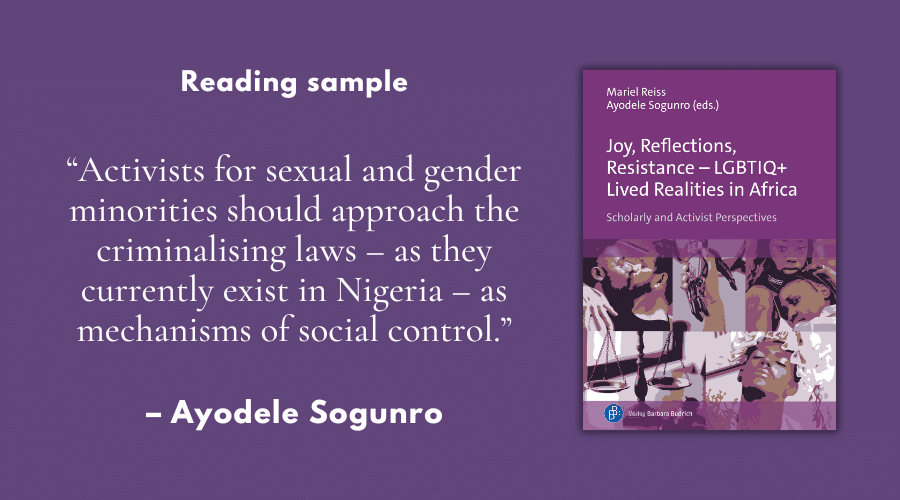
How do LGBTIQ+ people across Africa navigate violence, exclusion and resistance? Bringing together activist and scholarly perspectives from diverse African contexts, the volume “Joy, Reflections, Resistance – LGBTIQ+ Lived Realities in Africa. Scholarly and Activist Perspectives” edited by Mariel Reiss and Ayodele Sogunro explores lived realities, colonial legacies and practices of solidarity and the transformative potential of collective action. We share a reading sample from the fourth chapter contributed by Ayodele Sogunro.
p. 65–267
04 Confronting power dynamics in Nigerian criminal law: Opportunities for LGBTIQ+ activists
by Ayodele Sogunro
-
Introduction
The federal and state laws criminalising or discriminating against same-sex relationships and non-heteronormative sexuality and gender identity (‘the criminalising laws’) in Nigeria should not be mistaken for the misguided outcome of a pseudo-democratic process expressing the will of the general population. Instead, these criminalising laws reflect the power dynamics of Nigerian society by being part of the wider use of criminal law as a tool of hegemonic social control. This social control creates and maintains a system of moral panic and socio-economic segregation that ultimately targets the socially and economically vulnerable in society while protecting the privileged.
This chapter encourages queer rights activists to think not just in terms of human rights protections, but also in terms of power and how it is wielded and deployed across society. This engagement with power dynamics requires replacing abstract and generic human rights language with the concreteness of social and political action. A mere focus on legal change – such as with decriminalisation efforts – without confronting social and political structures of power would only filter the benefits of legal changes to those who already have some measure of power, and not to marginalised members of the queer community. In essence, for advocacy on behalf of sexual and gender minorities to be effective, activists must recognise how power dynamics influence the criminal justice system, and their work should address both broad systemic problems and specific issues facing queer communities. Given Nigeria’s dysfunctional criminal justice process, sexual and gender minorities targeted by discriminatory laws typically experience the same vulnerabilities and challenges as other marginalised groups.
This recommendation to pivot to political issues may seem radical in a human rights advocacy context because it veers away from the formal structures of human rights law and discourse, especially where it invokes dangerous ideas of revolutionary conflict, unconstitutional change, and social anarchy. However, in this chapter, I suggest that there are democratic ways to engage with power dynamics without compromising the safety and welfare of vulnerable individuals and society as a whole.
With this understanding in mind, this chapter draws out linkages between the criminalisation of same-sex relationships, the overall entrenchment of dominant power systems, and the existence of wider social exclusions in Nigeria. It formulates ideas on how advocacy in Nigeria can utilise these intersections for the better protection of sexual and gender minorities. Furthermore, it considers the possibility of democratic organisation and intersectional mobilisation in Nigeria as the most effective way of protecting sexual and gender minorities in Nigeria – that is, through the protection of every other vulnerable group currently excluded from social goods under the prevailing hegemony. In this chapter, I argue that there is a correlation between overall economic welfare of society and increased protection for sexual and gender minorities. I show that by intersecting their work with the marginalisation of other identities in Nigeria, activists for the rights of sexual and gender minorities in Nigeria can help create or accelerate this democratic organisation and mobilisation.
-
Linkages between the criminalisation of same-sex relationships and wider social exclusion in Nigeria
The experiences of LGBTIQ+ persons with law enforcement in Nigeria illustrate how power dynamics in the country interact with and have an impact on law enforcement in general. However, these experiences are not exclusive to sexual and gender minorities; in fact, they mirror the everyday realities of other Nigerians criminalised under different laws. In essence, vulnerable individuals living under the laws criminalising same-sex relationships in Nigeria face the same socio-economic, political, and legal challenges as vulnerable people whose identities and behaviours are similarly policed.
Contemporary hegemonic power dynamics in Nigeria are a legacy of colonial rule. The principal aim of colonial governance was to maintain societal stability to ensure steady flow of raw materials and cheap labour. Criminalisation thus became a default mechanism of social control (Osita-Njoku 2016: 11). Over the years, colonial rule has mutated into elite rule, but the underlying philosophy has not changed (Ake 1987: 6; Diamond 2015: 31; Sklar 1979: 531). Just as it would have been ineffective to demand that colonial governments uphold human rights without delegitimising the nature and distribution of power in the colonial state itself, it is equally ineffective today to expect Nigeria’s governing elite to respect rights without first interrogating and delegitimising the current elite-based hegemony.
The enactment and enforcement of the criminalising laws in Nigeria indicate that these laws serve social control in three distinct ways. First, criminal law operates as a tool of political homophobia, diverting attention from legitimacy crises, particularly during transitional periods. This instrumentalization of criminal law parallels the broader use of moral panics to justify the criminalisation of certain types of ‘petty offences’, as will be discussed below. Second, through policing, criminal law functions as a filtration system to control people of lower socio-economic status in the social hierarchy. This system applies to both LGBTIQ+ communities and the wider population, while simultaneously creating opportunities for law enforcement officials to extort vulnerable groups. Third, policing reinforces hegemonic morality by policing ‘respectability’ and marginalising those who do not conform. Again, the effects extend to both sexual and gender minorities and the broader society. In essence, criminalisation remains a tool of social control and, ultimately, social exclusion in modern Nigeria.
As such, activists for sexual and gender minorities should approach the criminalising laws – as they currently exist in Nigeria – as mechanisms of social control imposed by a dominant class to entrench their idea of social order and facilitate economic exploitation. As noted at the start of this chapter, the broader use of criminal law as hegemonic control is evident not only in laws targeting victimless crimes and petty offences but also in the deployment of serious criminal laws. In the following sub-sections, I discuss these linkages between wider social exclusions and the criminalising of same-sex relationships in greater detail.
***
Would you like to continue reading?
Order “Joy, Reflections, Resistance – LGBTIQ+ Lived Realities in Africa” in our shop or download as open access e-book
Joy, Reflections, Resistance – LGBTIQ+ Lived Realities in Africa
Scholarly and Activist Perspectives
edited by Mariel Reiss and Ayodele Sogunro