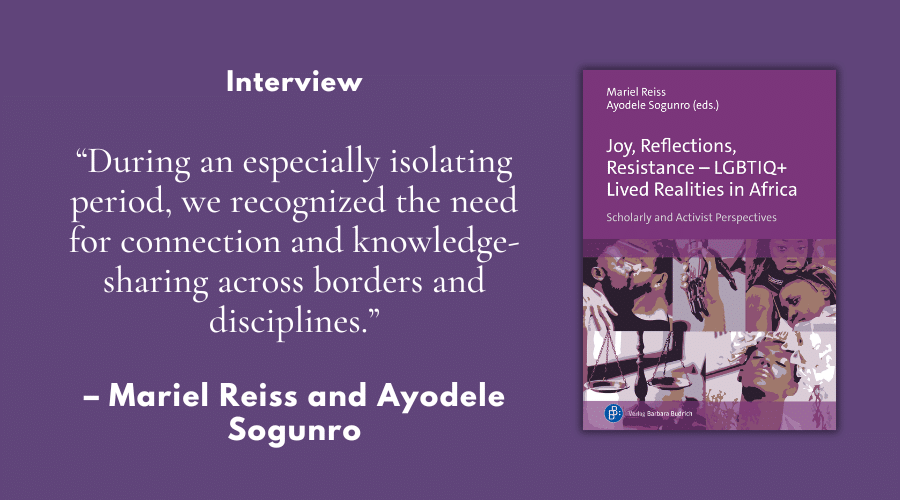
How do LGBTIQ+ people across Africa navigate violence, exclusion and resistance? Bringing together activist and scholarly perspectives from diverse African contexts, the volume “Joy, Reflections, Resistance – LGBTIQ+ Lived Realities in Africa. Scholarly and Activist Perspectives” edited by Mariel Reiss and Ayodele Sogunro explores lived realities, colonial legacies and practices of solidarity and the transformative potential of collective action. We have conducted an interview with the editors.
Dear Mariel Reiss and Ayodele Sogunro, what topics are you tackling in your publication, “Joy, Reflections, Resistance – LGBTIQ+ Lived Realities in Africa. Scholarly and Activist Perspectives”?
Our contributors focus on the diverse experiences of LGBTIQ+ persons across the African continent through both academic and activist voices. The book examines three central themes that shape these experiences today. First, we explore the continuing impact of colonial legacies on contemporary laws and attitudes toward LGBTIQ+ communities. Second, we investigate various forms of violence and discrimination that LGBTIQ+ persons face: hate crimes, hate speech, conversion practices, violence within LGBTIQ+ relationships as well as how intersectional factors like race, class, and gender interact to shape different experiences within LGBTIQ+ communities. Third, the book highlights strategies of resistance and solidarity including how activists across the continent engage in strategic litigation, build transnational networks, and preserve LGBTIQ+ histories.
How did the idea for this publication come about?
The book originated from a series of webinars that began in April 2022 during the COVID-19 pandemic: the Pretoria-Marburg Queer Conversations. Here scholars and activists from across Africa shared a space which was enabled through a collaborative effort of the Centre for Human Rights and the Centre for Sexualities, AIDS, and Gender – both at Pretoria University – together with the Center for Gender Studies and Feminist Futures and the Center for Conflict Studies – both at Marburg University. During an especially isolating period, we recognized the need for connection and knowledge-sharing across borders and disciplines. While academic and activist work share similar goals, they too often remain separate. Inspired by a spirit of community and shared learning, we set out to continue these conversations by creating a space that bridges the gap and serves as a resource that honours both scholarly and activist expertise, weaving them together into a common project.
What advantage do you see in bringing together scholarly and activist perspectives?
Combining these perspectives creates a more complete understanding of LGBTIQ+ realities in Africa. For instance, our chapters on colonial legacies benefit from both legal scholarship tracing the development of discriminatory laws and activist accounts of how these laws affect daily life. Similarly, our examination of conversion practices combines empirical research with activist strategies for supporting survivors and advocating for legal protections. We believe this approach enriches both academic and advocacy work. Most importantly, this collaboration creates knowledge that serves both scholarly understanding and practical change-making efforts.
What key challenges do your authors – whether scholars or activists – describe in their work? Do you notice any recurring patterns?
During the Pretoria-Marburg Queer Conversations the contributors and participants reflected on harmful and violent behaviour, legislations, and norms. We confronted shared realities of the still prevalent impact of colonial legacies, whether through criminalizing/discriminating laws and norms, legacies of forced binary understandings of sexuality and gender which go against pre-colonial lived realities in most African contexts, or the current impact of anti-LGBTIQ+ actors perpetuating those legacies. In the webinars and in the book, intersectional discrimination was a common theme and challenge. However, we deliberately centred and reiterated collective joy, solidarities, and resistances.
Who would you recommend this publication to?
We hope the edited volume resonates well with graduate students in the fields of political science, gender studies, sociology, and human rights. The chapters can be used as readings for undergraduate and graduate classes as well as primary and secondary accounts for researchers. Beyond the academic spaces, the contributions are resourceful for practitioners in human rights organisations, development agencies, and advocacy groups, as well as for activists and community organisers, policymakers and legal professionals. Last but definitely not least, we aim to reach readers without extensive academic backgrounds, and anyone interested in understanding contemporary LGBTIQ+ realities in diverse African contexts.
About the editors
 Mariel Reiss is a Senior Research Fellow at the Center for Conflict Studies at Marburg University. She works at the interdisciplinary Research Center Transformations of Political Violence where she examines changing interpretations and justifications of political violence, with a focus on their impact on LGBTIQ+ persons in Eastern and Southern Africa. She earned her PhD in Political Science from Marburg University and has since led the project LGBTIQ+ Rights in Multilevel Governance Systems, which investigated the negotiation and development of norms at both national and regional levels in Southern Africa. Since 2024 she has coordinated the DFG-funded scientific network Re-centering African Subjects and Subjectivities in regionalism research. Her broader academic interests include regional and international organizations, multilevel governance, human rights and LGBTIQ+ norms and rights discourses – with a regional focus on Eastern and Southern Africa.
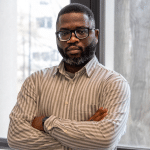 Ayodele Sogunro is a human rights scholar-practitioner who holds a Doctor of Laws from the University of Pretoria and a Master of Laws in Human Rights and Democratisation in Africa, where he was, until recently, a Senior Postdoctoral Fellow. His work addresses the protection of marginalised groups’ rights in Africa, with emphasis on sexual and gender minorities through law, strategic litigation and democratisation. He has conducted human rights advisory and research work for organisations including Amnesty International, the International Commission of Jurists, Network of African National Human Rights Institutions, Outright International, and the Initiative for Strategic Litigation in Africa. He previously served as Senior Legal Advisor at The Initiative for Equal Rights and Project Manager of the SOGIESC Unit at the Centre for Human Rights.
Order “Joy, Reflections, Resistance – LGBTIQ+ Lived Realities in Africa” in our shop or download as e-book
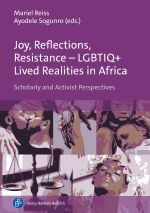
Joy, Reflections, Resistance – LGBTIQ+ Lived Realities in Africa
Scholarly and Activist Perspectives
edited by Mariel Reiss and Ayodele Sogunro