The publication “Global Trends: Prospects for Development and Peace. Multilateral Cooperation for People and Planet” edited by Cornelia Ulbert and Marcus Kaplan shows that rules-based multilateral cooperation remains necessary and possible in order to tackle the many global challenges we face. We talked with one of the editors Cornelia Ulbert to find out more about the idea behind the anthology and the series “GLOBAL TRENDS: Prospects for Development and Peace”.
The publication “Global Trends: Prospects for Development and Peace. Multilateral Cooperation for People and Planet” edited by Cornelia Ulbert and Marcus Kaplan is part of the newly released book series “GLOBAL TRENDS: Prospects for Development and Peace” edited by the Development and Peace Foundation (sef:) and the Institute for Development and Peace (INEF) at the University of Duisburg-Essen..
Dear Cornelia Ulbert, what is your new book series Global Trends: Perspectives for Development and Peace about?
The world appears to be becoming ever more complex and increasingly characterised by conflict and the unilateral pursuit of interests, particularly through military power. As a result, there is much talk about the return of great-power politics and the end of a rules-based international order and the multilateralism built upon it. Our research shows, however, that this perspective does not reflect the full range of international interactions and that multilateral cooperation is indeed still possible.
By opening up alternative perspectives, we seek to highlight options for action on how conflicts can be addressed and avoided. One of the most effective ways to achieve this is by promoting sustainable development processes. Reducing inequalities and improving living conditions worldwide can help to diminish the potential for conflict and prevent outbreaks of violence. Moreover, the knowledge that current developments can be countered can empower those who make political decisions as well as those who are engaged in practical work.
How did you come up with the idea of editing this series?
With this new series, we are essentially returning to our roots. Our partner organisation, the Foundation for Development and Peace (sef:), based in Bonn, and the Institute for Development and Peace (INEF) at the University of Duisburg-Essen published a book series titled Global Trends for many years. It became a standard reference work for many staff members in ministries and non-governmental organisations. However, compiling such a compendium every two to three years, based on up-to-date data and the latest reports from international organisations, was extremely labour-intensive. As databases and reports increasingly became available online and free of charge, we felt that the long production times meant we could no longer guarantee the necessary level of topicality, and we discontinued the series in 2015.
In making that decision, however, we overlooked another important aspect of the series: Global Trends had always also been a “guide to understanding the world”. This led to the idea of once again providing thematically focused orientation in a complex and volatile world, this time in a somewhat more compact format.
How is the series structured?
With this series, we aim to explain longer-term trends on the basis of data and scientific findings in order to place current problems – which can only be addressed globally – within a broader context. This also requires readers to engage with perspectives that may at times be unfamiliar. In the so-called “Global North”, we sometimes tend to lose sight of the fact that the world is more diverse and includes far more countries than those of the so-called “OECD world”, that is, the world of developed countries. Particularly at a time when long-standing certainties – such as an unshakeable transatlantic alliance – seem to be dissolving, such a widening of perspective may open up new possibilities for shaping the future.
As we address global challenges across four thematic areas – “Global Governance for Development”, “Peace and Security”, “World Economy”, and “Environment and Natural Resources” – the series is published bilingually in German and English and as Open Access in order to make it accessible to as many people as possible. Since preparing publications with processed data and visualisations remains very time-consuming, we plan a biennial publication cycle. The aim of the series is to present the state of research in a way that is understandable for non-experts and to derive recommendations for action from it. Ultimately, readers should be enabled to make informed decisions themselves.
The first volume focuses on multilateral cooperation for people and the planet. Why did you choose this focus?
There is no doubt that global power structures and the associated concepts of order are changing, and autocratic tendencies are increasing worldwide. It is therefore understandable that there is much debate about the state of multilateral cooperation and whether it still has a future.
Not only in Europe is there currently significant investment in military rearmament. Beyond any military security threats, however, many urgent problems persist or are intensifying – such as the consequences of climate change. Addressing these challenges collectively offers opportunities to reduce inequalities worldwide and to improve people’s living conditions within planetary boundaries. We aim to show that, beyond unilateral power politics, there are still “spaces of possibility” for dialogue about differing interests in which multilateral negotiation processes can take place.
Why we editors chose Budrich
As academics, we wanted to publish our research findings with a scholarly publisher that also operates internationally. At the same time, it was important to us to have a direct and reliable contact person who would coordinate the production process transparently. Our timetable was also ambitious, as we wanted to maintain a certain degree of topicality. With Verlag Barbara Budrich, we found the right partner, offering all services – from copy-editing to the preparation of graphics and the print-ready version – from a single source and implementing them efficiently, while maintaining the level of quality that was important to us.
About Cornelia Ulbert
 Dr Cornelia Ulbert has been Executive Director of the Institute for Development and Peace (INEF) at the University of Duisburg-Essen since 2006, holds a doc-torate in political science and is specialized in International Relations. One of her main research areas is global governance, with a particular focus on non-hierarchical forms of governance, norm-setting processes and compliance. Among other things, she examines the role of private actors and the question of civil society participation in global political processes, especially in global health.
Her academic career includes positions at the Universities of Mannheim and Konstanz, the European University Institute in Florence and the Free University of Berlin.
For more information see: www.uni-due.de/inef/cornelia_ulbert_en.php
Order “Globale Trends” in our shop or download as e-book
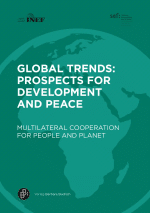
Global Trends: Prospects for Development and Peace
Multilateral Cooperation for People and Planet
edited by Cornelia Ulbert and Marcus Kaplan