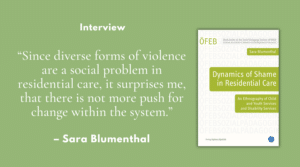
What role does shame play in everyday life in residential care? Based on ethnographic research in Austrian youth care institutions, the publication “Dynamics of Shame in Residential Care. An Ethnography of Child and Youth Services and Disability Services” uncovers how shame emerges in responses to violence. We share a reading sample from chapter 2, “References to affect and shame theory” .
pp. 25–28
2.2 Social functions of shame: relationship regulation
A fundamental concern of this study is to convey that shame is not a “pathological” feeling, but rather an important regulatory mechanism in people’s relationships with themselves and with each other (Hilgers, 2012). The comprehensive, interdisciplinary work on shame by the American sociologist Thomas Scheff also takes this line of argumentation as its starting point. Scheff’s work is categorised as symbolic interactionism and is also strongly represented in the German-speaking discourse, as Scheff has worked out the social function of shame in regulating social relationships (Adloff, 2013).
Scheff’s integrative approach is characterised by the fact that he develops a very broad definition of shame. In his understanding, society is based on the fact that people can enter into relationships. According to Scheff, preconscious and unconscious affects provide information about the state of a relationship. While pride signals connectedness, shame has the function of conveying a “threat” to social relationships (Scheff, 2014, p. 257). The, usually diffuse, experience of shame thus serves to feel the state of social relationships on a continuum between connectedness and rejection or alienation, thereby avoiding potential conflicts by means of adaptive behaviour (Scheff, 2014). Alongside pride, shame thus forms the affective basis of socialisation processes.
Scheff argues that his broad concept of shame implies “typical” psychological definitions of shame, such as “dissatisfaction with self”. Firstly, he criticises this definition of shame for not implying the crucial component of social relatedness to other people. Secondly, Scheff criticises the fact that psychological definitions of shame do not capture the fact that shame serves to balance even the smallest threats to social relationships (Scheff, 2000). This is why Scheff, drawing on Goffman’s work, also subsumes embarrassment under the term shame (Scheff, 1988).
I follow Scheff’s approach to shame for this empirical work primarily for methodological reasons. If I want to investigate shame as an interpersonal affect on the basis of its expression, starting from my empirical data, a broad understanding of shame is more suitable for an initial approach to the data than the existing, very detailed internal dissections regarding the intrinsic experience of shame (Wurmser, 1997). However, it should be noted that psychoanalytical theories of shame in particular also take relational aspects into account (Hilgers, 2012).
Against the background of a broad, open view of shame that is well suited to a Grounded Theory study, Scheff also assumes a close relationship between guilt and shame. From Scheff’s perspective, guilt can be categorised as part of the “shame family”, as shame, which he also describes as a “master emotion”, has a more profound socio-regulatory function than guilt. Guilt does not hurt the self, but is located at the level of (omitted) action (Scheff, 1990). In a nutshell, it can be said that guilt, unlike shame, does not refer to the violation of the self, but to the (potential) violation of others.
Scheff is also heavily involved with the work of the American sociologist Charles Cooley.
“It was Charles Cooley (1922) who formulated the idea of the looking-glass self (LGS), now an accepted part of modern social psychology and symbolic interaction. This idea contains two fundamental proposals. First, self-consciousness involves continually monitoring self from the point of view of others. As Cooley put it, we ‘live in the minds of others without knowing it.’ Second, living in the minds of others, imaginatively, gives rise to real and intensely powerful emotions, either pride or shame.” (Scheff, 2005b, p. 147)
According to Scheff, it was Cooley who added a social component to the psychological definition of shame. In the logic of the LGS, shame or pride arises from the idea that we are perceived by others and the resulting idea of how others evaluate us (Cooley as cited in Scheff, 2014, p. 255). With reference to Cooley, Scheff defines shame as a socially regulative affect that signals even the smallest threats to social relationships through the imagination of the evaluation of the self by others (Scheff, 2014, p. 257).
Scheff assumes that the alienation from others is a central cause of shame. In his thinking, “modernity”, which is characterised by individualisation, conveys the idea that you can “make it on your own”, that you are independent of others and complete in yourself − the importance of social relationships is thus misjudged. Feelings of shame tend to be concealed due to the cultural ideal of independence. Scheff understands the experience of shame as a signal for “alienation” − and since relationships in modern societies tend towards alienation, he sees shame as omnipresent. From this perspective, emotional distance from others, which is enforced by social conditions, can be experienced as a devaluation of the self, which generates shame. The avoidance of further shame can thus lead to social withdrawal, depression as well as aggression or violence. Scheff also shows that shame acts as an initiator of violent behaviour (Scheff & Retzinger, 2001). Shame can therefore also be a valuable level of analysis particularly with regard to working and living conditions in residential care facilities. In English-language research on Social Work, Scheff’s theory of a “deference-emotion system”, proposing that shame and pride interact in the regulation of social relationships, has informed subsequent theoretical and empirical work. Gibson (2019) demonstrates that pride can also have destructive and shame can reveal constructive dynamics, such as those that promote social cohesion. For example, Gibson argues that pride can lead to professionals putting pressure on addressees – and shame can encourage ethical reflection on professional behaviour.
In the context of socio-theoretical references to “Western society” and “modernity”, Scheff assumes that shame in “Western” societies has the fundamental socio-regulatory function described above, but is usually concealed or repressed. He attributes the “low visibility of shame” in Western societies to their orientation towards individualism (Scheff, 2014). Scheff assumes that shame is omnipresent in “Western” societies, regulates social relationships above all at the level of the unconscious or preconscious and takes on particularly covert forms of expression. The low visibility of shame is also reflected in the thematic horizon of Western science. The sociologist uses the works of Simmel, Cooley, Elias, Sennett, Lynd, and Goffman to discuss the fact that shame plays a fundamental role in the major sociological theories, but is not named as such. Instead of shame, which always emphasises people’s social interdependence, the emotion of fear, for example, which refers less directly to people’s social dependencies, is dealt with scientifically. This “low visibility of shame” is reflected in the extent to which it can be adequately researched. According to Scheff, studies that investigate the conceptualisation of shame (using questions such as “Do you remember a shameful situation?”) cannot adequately capture the relevance of shame (Scheff, 2000). This results in particular in challenges for qualitative research into shame as affect − the methodological handling of this is described in the third chapter of this study.
Scheff’s perspective on the differentiation between shame and guilt has already been briefly touched on. The differentiation of shame and guilt that he proposes − along the distinction between being and doing − is the most common differentiation of these two affects, which is also used in psychoanalytical discourse, for example (Tiedemann, 2013). The interwoven nature of the experience of affects can only be investigated to a limited extent in this qualitative study, with reference to the experience of the researcher or with reference to explicit narratives about the emotional life of field participants. For this reason, the present study focuses methodologically on the expression rather than the experience of the field participants’ affects. From the theoretical discourse on shame and guilt, however, it should be added that from Scheff’s sociological perspective on emotions as well as from a psychoanalytical perspective, the experience of shame and guilt appears interwoven.
At the level of empirical work with affect expressions, no clear mimic expressions or physiological reactions can be assigned to the affect of guilt – but they can be attributed to shame (lowering one’s gaze, falling silent, etc.) (Lammers, 2020). With regard to the relationship between shame and guilt, it can therefore be said that both affects are examined in this qualitative empirical study. However, the expression of guilt can more readily be inferred from verbal utterances − such as apologies or attributions of guilt − whereas in the case of shame, sometimes very distinct physical reactions may serve as expressive behaviour. Overall, the theory and empirical findings of the present study suggest that shame and guilt should not be understood as separate entities, but rather as interfaces of affective experience and expression that serve to regulate conflicts and social relationships.
As outlined above, Scheff’s integrative shame theory is strongly influenced by symbolic interactionism. The special contribution of Scheffs shame theory lies in the detailed elaboration of the social regulatory functions of shame on a relational level. References to “modernity” or “Western society” are used to suggest links to an overarching social theory. In line with symbolic interactionism, the body does not play a role in Scheff’s considerations, but Scheff’s theory sheds detailed light on the connection between cognitions, relationships, and shame. As already indicated by Penz and Sauer’s reference to the interweaving of affective and body turn, corporeality can, however, be understood as a valuable level of analysis for the social functions of shame.
***
Would you like to continue reading?
Buy “Dynamics of Shame in Residential Care” or download as open access

Dynamics of Shame in Residential Care
An Ethnography of Child and Youth Services and Disability Services
by Sara Blumenthal
Interested in more reading samples or exciting interviews? Have a look at our blog.