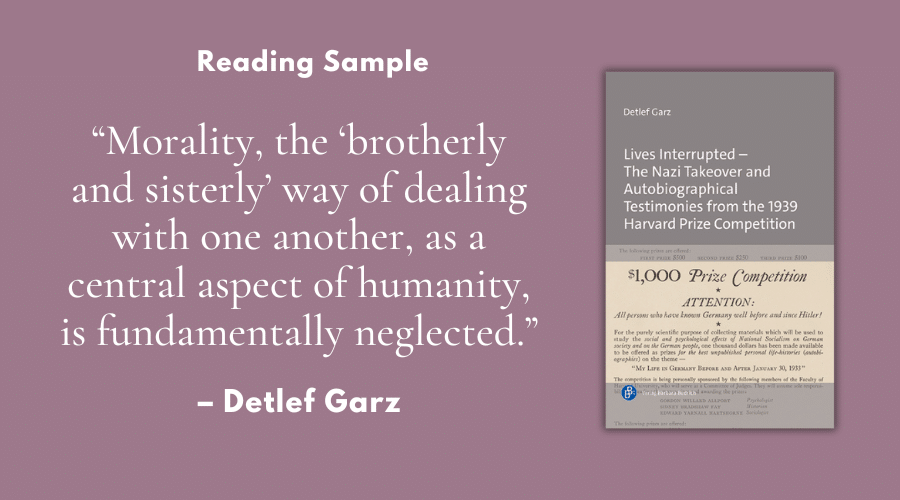
Detlef Garz’s “Lives Interrupted – The Nazi Takeover and Autobiographical Testimonies from the 1939 Harvard Prize Competition” sheds light on a remarkable yet little-known collection of autobiographical accounts written by emigrants from Nazi Germany and Austria. Based on manuscripts submitted to a 1939 Harvard University competition, the book explores experiences of persecution, resistance, exile, and resettlement — offering a powerful insight into lives disrupted by National Socialism and the lasting impact of moral misrecognition. We share a reading sample from the book.
p. 226–230
III. Neither Solidarity nor Justice nor Love
-
Basic Features of a Morality of Recognition
Looking at the autobiographies presented, a common and overarching aspect comes to the fore. Morality, the ‘brotherly and sisterly’ way of dealing with one another, as a central aspect of humanity, is fundamentally neglected. I would first like to illustrate this idea with an example. In one episode of the American drama film ‘Grand Canyon’ (1991), a motorist, a Los Angeles lawyer, is shown trying to get around a traffic jam and ends up in an inhospitable area where his car eventually breaks down. While waiting for the tow truck, this man, a white man, is surrounded and intimidated by a group of colored youths. Just before the conflict comes to a predictable end, the tow truck arrives and the car mechanic, a muscular man, also a colored man, emerges from the vehicle. He is about to begin his work, then realizes the situation, puts his 80 cm wrench to the ground and turns to the group and its leader:
“‘Folks,’ he says forcefully, ‘you know this isn’t the way it should be. I should be able to do my job; the man should be allowed to go home to his family; and you smart fellows should have a job that gives you pleasure and feeds you.’ Then he takes up … the work. But the gang leader does not give way. He wants to know if the other respects him. He straightens up, turns around, looks him up and down and says: ‘Yes, I respect you.’ ‘Me? – or this?’ The gang leader points to his pocket. The huge man, after a moment’s hesitation, ‘I saw your gun.’ Thereupon the leader signals his men to retreat” (von Hentig 1993, p. 23).
Hentig comments only briefly on this episode: It “shows what truthfulness coupled with cleverness can accomplish – dropping one’s own weapon and touching the denied longing of the other” (ibid.).
My text will first deal with this longing for respect and recognition as a basic prerequisite of human coexistence. In a more detailed second step and in a reversal, I want to address social action in the sense of offence and degradation under the heading of biographical misrecognition. Jürgen Habermas introduced the concept of ‘morality’ both from an anthropological and a developmental or biographical perspective.
“‘Moral’ is what I would like to call all those intuitions that inform us how best to behave to counteract the extreme vulnerability of persons through sparing and consideration. … Morality can be understood as a protective device that compensates for a vulnerability that is structurally built into sociocultural forms of life. In this sense, living beings that are individuated solely by means of socialization are vulnerable and in need of moral protection” (Habermas 1986, p. 20; emphasis in the original).
The idea of moral protection was taken up and developed further by Axel Honneth in his publication ‘The Struggle for Recognition’ (1995). For him, recognition comprises the following three elements.

In these developmental steps, the diffuse action of the young child is first of all replaced by role-based action and the latter in turn by the recognition of individual differences within the framework of social solidarity.
-
Moral Misrecognition
Against this background, I would like to talk about misrecognition of emotional attachment, rights, and solidarity. To be able to show this, I will analyze the autobiographical contributions of the Harvard project either from the point of view of moral non-recognition or misrecognition.
2.1 Non-recognition – Refused solidarity, refused rights
I first deal with the case of not granted or ‘denied’ recognition in the form of disrespect and illustrate it mainly by means of the ‘concept of honor’. Although the formal legal act of equal rights for Jewish citizens was ratified in Austria in 1867 and in Germany in 1871, one cannot assume a relationship of solidarity between non-Jewish and Jewish Austrians or Germans in large areas of social life, neither in the First Austrian Republic nor in the German imperial period or in the Weimar Republic. Exclusions in the sense of deprivation of honor were the rule. For example, Jewish Germans could not as a rule acquire membership in associations, and male university youth were also barred from joining student fraternities.[1]
“Thus, the corps in their entirety and a very large part of the fraternities refused to admit Jews and also refused to give Jews satisfaction; that is, to effect honorary dealings with them in the manner of students” (Hermann Klugmann, Ms. 113, p. 14).
In concrete terms, this form of non-recognition in the sense of the failure of a solidarity based on the notions of respect for honor of the time could take the following form: Edmund Heilpern, born in 1892, describes an event from his time as a student, which is is related to a challenge to a duel that was to take place in Vienna in about 1911.
“We appeared at the coffeehouse, the Astoria, at a predetermined table, at the appointed time. A minute later the seconds of Gustav A appeared. Short formal introduction. Then one of the seconds, an older fraternity student, opened the meeting with the question: ‘Before we go into details, I am obliged, according to the rules of my association, to ask: Are the gentlemen Aryans?’ We were prepared for the question. Nevertheless, we were surprised since we had assumed that this so-called ‘Aryan paragraph’ was only a bluff. Now we saw that it was harsh reality.
My self-control was useful this time and so I calmly answered: ‘I am a Jew’. Nevertheless, my heart was pounding up to my throat. I think it was the first time in my life that I had to say this sentence.
Kurt R. was not so composed. He stammered: ‘How do you gentlemen mean that… I am a Catholic, … my mother is Catholic…, my father was Jewish, … now also a Catholic’.
The other side kept a calm face. The elder answered stiffly and formally: ‘The religion doesn’t matter – the blood alone is decisive – since my connection professes the Weydhofner (sic) principle,[2] we are unfortunately not able to recognize the gentlemen as seconds’. Stands up, clicks his heels together, leaves.
We knew what the Weydhofner principle was. That accursed paragraph which was incorporated into the statutes of the national student fraternities – it was in 1905, as far as I remember – the paragraph:
The Jew is unworthy and without honor. So, he can neither demand nor give satisfaction” (Edmund Heilpern, Ms. 92, p. 18).
Even in the narrative rendition of the incident, which, contrary to the statement in the text, was not mastered very confidently by the two students who were declared to be Jewish, one can clearly see the excitement and the accompanying irritation of the author.
But other areas of social life were also affected by this form of ‘honorcutting’ non-recognition, as the following episode, also reported by Edmund Heilpern, reveals:
“I was a member of the ‘Lutinists’, an amateur orchestra for the cultivation of historical music. I played the guitar, was the second concertmaster, and had just passed my conservatory exams with ‘very good’. I loved music passionately and the evenings in the orchestra of the Lutinists were part of my happiness. The Lutinists were organized as a club. To become a member, one had to pass an examination and then a ballotage (a secret ballot with white or black balls; DG).
I had a university colleague who was also my student in guitar. I introduced her to the Lutinists. She passed the musical exam excellently. Then came the ballotage. After a few days, the conductor, who was also the president of the club, said to me, ‘Miss X has been rejected’. He was quite embarrassed but finally admitted that Miss X would meet all the requirements. She was musical, from the best family, very wealthy, unusually educated, pretty, idealistic………but she was Jewish, and several members of the Lutinists, although not at all anti-Semitic, would prefer to avoid being so closely associated with a Jew” (ibid., p. 16).
Finally, this ‘will to social exclusion’ can also be seen on a society-wide level in the census ordered by the Prussian Minister of War von Hohenborn in October 1916 on the participation of Jewish men in the First World War.
“Like my son and all the other Jewish participants in the war, I had to endure the ominous ‘Jewish census’. This and the accusation of ‘shirking’ made us very bitter at that time” (Joseph Levy, Ms. 134, p. 24).
Exclusions of this kind were quite familiar to the Jewish population, as Böckenförde addresses under the heading of ‘betrayal of the citizen’: “Animosities within society in a time of spreading anti-Semitism were something [Jewish citizens; DG] were familiar with; they could take it calmly, because they knew that as citizens they were protected by the state” (Böckenförde 1997, p. 167). In fact, this trust in the German state, in its laws and its ordinances, was virtually unwavering until well into the National Socialist era. How strong and unbroken these expectations were is evidenced by Leo Grünebaum’s statement:
“In short, when I reflect on those decades before Hitler, I am overcome by a feeling of security, safety, self-evident equality, and a sense of how healthy the core and mass of the German people were in their inner and ethical structure. This feeling had sat so firmly in me through a lifetime that (…) on November 10, 1938, when I learned early in the morning that the synagogues in Cologne were going to burn and that ‘pogroms’ had taken place, I at first thought it an abominable fairy tale, impossible within the German people, despite all that we had already experienced since 1933” (Leo Grünebaum, Ms. 84, p. 7).
In this respect, it is also understandable that thoughts of the dangers caused by the ‘situation bereft of rights’ seeped into the consciousness of those affected only very slowly. Thus, on July 24, 1933, the teacher Heinrich Lichtenstein, still trusting in the rule of law, but also recognizing the danger, turned against his dismissal from the teaching profession as ‘nationally unreliable’ with a request to ‘the high Hessian ministry’.
“With a clear conscience I can affirm that I have always performed my duties faithfully and conscientiously. I have always made every effort to educate the youth entrusted to me in a patriotic spirit, just as the fulfillment of my personal duties to the fatherland was a matter of course for me” (Heinrich Lichtenstein, Ms. 138, p. 49).
A further step was the misrecognition of identity through deprivation of rights. This was especially difficult for many Jewish Germans to comprehend, as they could hardly be outbid in patriotism:
“We were happy, cheered the reported victories together with the entire German people, we followed the progress of the army in spirit with them, and we were, like all of Germany, kept upright in the belief of an eventual victory” (Joseph B. Levy, Ms. 135, p. 24f.; regarding the First World War).
Later, Joseph Levy reports a conversation with two members of the NSDAP in which he still revealed his position at the end of 1933:
“What am I less than you? Have I ever violated my duties against Germany? Have I not served the fatherland with my children? I will not let you and all your party comrades surpass me in my patriotism, in my deep love for the German fatherland. My ancestors were born in it and planted in me the love for Heimat. You will not tear it from my heart” (ibid., p. 31).
[1] See Elias 1992 for a more theoretical description.
[2] The ‘Waidhofen Principle’ was proclaimed by the ‘Waidhofener Verband der wehrhaften Vereine Deutscher Studenten’ (Federation of Fortified Associations of German Students) in 1896.
***
Would you like to continue reading?
Order “Lives Interrupted – The Nazi Takeover and Autobiographical Testimonies from the 1939 Harvard Prize Competition” in our shop or download as e-book
by Detlef Garz
Interested in more reading samples or exciting interviews? Have a look at our blog.