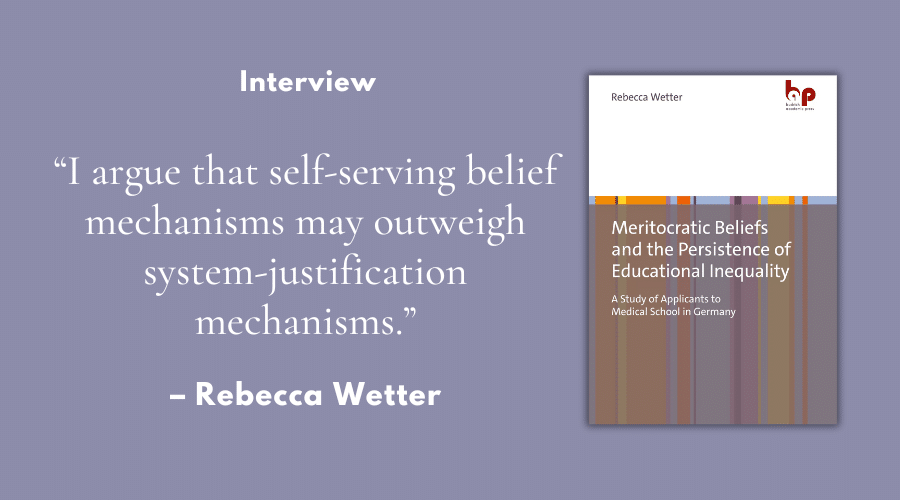
Educational success remains strongly linked to social background. However, there is no growing concern about this, which could be explained by meritocratic beliefs that success primarily depends on individual effort and talent. In her publication Rebecca Wetter “Meritocratic Beliefs and the Persistence of Educational Inequality. A Study of Applicants to Medical School in Germany” examines how such beliefs are shaped by experiences and what consequences they have for the reproduction of educational inequality. We have conducted an interview with the author.
Dear Rebecca Wetter, what questions are you addressing in your publication Meritocratic Beliefs and the Persistence of Educational Inequality?
At the centre of my book, which is based on research from my dissertation project, are meritocratic beliefs – beliefs that success primarily depends on individual effort and ability rather than on luck or social background. Using longitudinal data on medical applicants in Germany, I examine how meritocratic and nonmeritocratic beliefs are shaped by individual educational experiences and parental education, and how (differences in) those beliefs may legitimize and reproduce educational inequality by affecting applicants’ distributive preferences and persistence in goal pursuit after a first rejection.
Which belief mechanisms most frequently shape applicants’ inequality beliefs, or which ones have the greatest influence?
Theoretically, I am discussing the different mechanisms of self-serving beliefs and system-justification in the formation of inequality beliefs. For the context of application to medical school, I argue that self-serving belief mechanisms (i.e., the formation of beliefs that serve one’s own self-image) may outweigh system-justification mechanisms (i.e., the formation of beliefs that rationalize the way the system is). Indeed, I find that success or failure in admission shapes applicants’ inequality beliefs in a self-serving way: Getting admitted increases their beliefs that their own success in admission depends on their effort, while getting rejected increases their beliefs that their failure depends on luck or lack thereof. I also discuss that in a broader societal context, system-justification mechanisms may play a larger role in belief formation, as truly disadvantaged groups in society may avoid strong beliefs about the importance of social background for success, as these beliefs could potentially have negative psychological consequences on people’s vision of their future.
You conducted your study on applicants for medical school. What is particularly interesting about this group?
Admission to medical school in Germany is highly selective, but it also offers high returns on the labor market in terms of income and prestige. Hence, receiving the admission decision is a crucial event for all applicants. Measuring their inequality beliefs before and after getting admitted or rejected allows studying how these educational experiences of success or failure shape (non)meritocratic beliefs about their own admission but also beliefs about factors behind societal success more broadly. Furthermore, the group of medical applicants has above-average school grades and high career aspirations. By focusing on this group, I study the belief formation among the winners of the educational game – a group that is likely to become the educational decision-makers of the future.
Which questions would you like to pursue following this research?
The quantitative analysis of the longitudinal survey data was a unique opportunity to study the formation of inequality beliefs and their consequences for the legitimation and reproduction of inequality. Beyond the causal effects of success or failure in admission, I also found differences in inequality beliefs by social background and school grades. To understand more in-depth which specific experiences in educational institutions are the mechanisms behind these associations, I plan to conduct qualitative follow-up interviews with the survey participants. Furthermore, in these interviews, I want to test how inequality beliefs can be altered by short interventions, as promoting a more balanced understanding of factors behind educational success may be a crucial tool to increase support for inequality-reducing policies and create a more just educational system with equal opportunities for all students.
That’s why I have chosen Budrich as my publisher…
I chose Budrich because it is a leading publisher in the fields of education, social research, and inequality, making it the ideal platform to reach the audiences most relevant to my work. Several colleagues also recommended Budrich based on their positive experiences with its supportive and attentive editorial process, which I have now also experienced firsthand.
About Rebecca Wetter
 Dr. Rebecca Wetter is currently a postdoctoral research fellow at the University of Potsdam, working on an interdisciplinary project on multidimensional heterogeneity in the classroom. Before this position, she was a research fellow at the WZB Berlin Social Science Center and PhD Candidate at the Free University Berlin. Her research interests include social and educational inequality, the formation of attitudes and beliefs, as well as intergroup contact and diversity.
Order “Meritocratic Beliefs and the Persistence of Educational Inequality” in our shop or download as e-book

Meritocratic Beliefs and the Persistence of Educational Inequality.
A Study of Applicants to Medical School in Germany
by Rebecca Wetter
Interested in more exciting interviews? Have a look at our blog.
