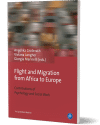
 New with Budrich: Flight and Migration from Africa to Europe. Contributions of Psychology and Social Work by Angelika Groterath, Viviana Langher and Giorgia Marinelli (eds.).
About the book
This publication collects contributions to understanding and addressing migration flows from Africa to Europe and supporting social coexistence in the destination countries. Written by experts in psychology and social work, the articles approach the topic of immigration based on empirical research in their academic and professional specialties. The book focuses on issues of intervention, letting the research be the starting point for further plans. This focus makes the book valuable for professionals as well as policy makers.
Shot vitae:
 Angelika Groterath studied psychology, made a Ph.D. in sociology and trained in psychotherapy with a focus on psychodrama. She is dividing her time between Germany and Rome since 1990 and has been a professor of psychology at Hochschule Darmstadt since 2006. Before, she was working as an international consultant, assessed projects in remote locations as Somaliland, and trained professionals in South America and in Egypt. She has worked on HIV/AIDS and injecting drug use throughout all these years. Her clients were the UN, INGOs and the European Commission. Emergency psychology was her main concern in the Gaza Strip (Médecins Sans Frontières) in 2001 and in Baghdad after the bombing of the UN in 2003 (UN Security Coordinator). Angelika took her first professional steps in 1980 – and will retire soon! She has published in German, English and Italian. Last publication: Migration and Refugees: Global Patterns and Local Contexts. With D. Leith and K. Habtemichael. Nova Publishers, N.Y. 2018.
 Viviana Langher graduated in psychology at Roma University “Sapienza”. She has a PhD in clinical psychology and is a Professor (habil.) of clinical psychology. Since 2003 she belongs to the staff of the faculty of psychology of “Sapienza” university. She was the scientific head of international projects aimed at supporting the quality of inclusive processes in foreign countries, namely in Serbia, North Macedonia and Mozambique. She was head of the Italian unity of a bilateral project Germany – Italy on inclusion of migration flows which was a component of the international cooperation project AguaFutura in Central America, granted by the Italian Ministry of Foreign Affairs. Viviana’s research activities are focused on; qualitative and quantitative analysis of inclusive processes in Italy and abroad, migration flows and their impact on local culture, gender-based violence, the unconscious of territories and communities and methodologies of evaluation of psychological clinical intervention. Last publication: Development and validation of the Dynamic Career Scale (DCS): a psychodanymic conceptualization of career adjustment. With A. Caputo and C. Fregonese. International Journal for Educational and Vocational Guidance. 2020.
 Giorgia Marinelli studied psychology (B.Sc. and M.Sc.) at Sapienza University. In 2016 she spent six months as Erasmus scholar in Darmstadt where Angelika was teaching in Social Work. She and Viviana agreed about a program that made the discipline overlap possible and met MA requirements. The program included an internship in a so called “integration facility”. Giorgia wondered why apart from professionals, there were no Germans in these facilities. Her observation triggered further research on integration and migration and is, in the end, the reason for this book: The Viernheim study is Giorgia’s MA thesis. In 2019 she was granted a post-graduate fund and returned as a scholar to Darmstadt for further research on the unconscious of communities and for preparing the summer school. Back in Italy, she began collaborating on migration with Prof. Marzana from the Catholic University in Milan. Currently she is also working on a survey of young people in Milan on the impact of the Corona pandemic on their relationship life.
1) Dear editors, please summarize the content of your current publication Flight and Migration from Africa to Europe for our readers.
We have long been in a personal and academic dialogue about the European way of dealing with migration and integration and the question of what psychology could contribute. In 2018/19 it seemed to us that “simple thinking” dominated the public discussion. We wanted to participate in the public debate, offering a scientific, multidisciplinary, multi-professional contribution, with the idea that a patient exploration of the phenomenon could help to overcome militant contrapositions. This volume is, indeed, enrooted in a multidisciplinary background, but a pre-eminent contribution is due to psychology. We want to share a particular theoretical perspective that is offered in Italian universities: clinical psychology, based on psychoanalysis, aimed at exploring and intervening in social contexts. Differently from what is normally intended by the term “clinical psychology”, often focused on psychopathological individuals, this “Italian” theoretical perspective is interested in analyzing the emotional dynamics modeling people behaviour and sense-making in a tight relationship with their culture and social context.
Among the works collected in this volume are, however, also essays that have nothing to do with psychology – but that take up the question of communication with the immigrants, for example, or illuminate the juridical aspects of mixed migration. The different chapters of this volume wind through a multi-perspective dialogue, where studies and research, as well as descriptions of services to support migrants and refugees and case studies took part in building this common narration.
We are convinced that migration from Africa, and in particular from sub-Saharan Africa to Europe, is of major importance, a flow that Italy rather than Germany currently has to deal with. But we have also included works that deal with refugees from Syria – whether they travel to Europe via Africa or via Turkey. We decided to publish all the papers presented during the summer school in order to share and make accessible the common effort of all the speakers to offer a meaningful perspective, a rational view and a passionate attitude.
2) How did you get the idea to write this book?
The book is the outcome of a summer school with the same title that we were able to hold in Rome in June 2019 with the support of the German Foreign Office via DAAD. The summer school itself was a fruit of our long-standing German-Italian cooperation. We have been working on flight and migration for some time already, shedding light on aspects that remain hidden in the mainstream discussion: We are psychologists and are concerned with the challenges that flight and migration pose on a human level – to those who have to integrate migrants as well as to those who migrate. This double emphasis may surprise some in Germany. But we are standing in the tradition of Italian psychology and psychoanalysis, which is as much focused on communities as it is on individuals and as much focused on health as it is on disease.
Our main point of reference is the school of Renzo Carli, psychologist and psychoanalyst, Emeritus of the Sapienza University. And we are proud that we could win Prof. Carli as the key speaker and as author for a chapter in this book. The book gives us the opportunity to confront our ideas with the views of colleagues from different academic disciplines from three European countries: Germany and Italy as EU member states and North Macedonia.
3) From the perspective of psychology and social work, what are currently the greatest challenges for migration research?
Today, in the summer of 2020, the biggest challenge for migration research is undoubtedly the fact that resources, nerves, people and funds are all tied up in Corona and Covid19 and that flight and migration are only marginally of concern. From a psychological perspective, however, beyond Corona it is still of interest how we come together: we, the Europeans, and they, the migrants from Africa and elsewhere. For us Europeans, this implies: What fears do we have, how do we deal with these fears? And what talents and opportunities do we have, and how can we use them? Social work, on the other hand, should become aware of its interdisciplinary excellence and integrate psychological perspectives into its own action maxims just as much as the sociological theses and data currently dominating migration research. It is human beings who must act, and we should try to understand them and help them to enhance their choices of action.
4) How do you think these challenges will change in the coming years?
Major changes, especially in a favourable direction, are not in sight in the near future; the pandemic and its economic and social impact are too crucial. What is however both possible and desirable is that the pandemic may make us (Europeans) more sensitive and empathetic – and that also those who have the financial means to support scientific research pay more attention to humanity again.
5) This is why we are authors with Barbara Budrich:
Barbara Budrich is actually the first address for us when it comes to presenting socially relevant topics and their reappraisal to an academic audience. There are hardly any other publishing houses that are as convinced of the value of the social sciences and humanities for society at large. Furthermore, and extremely important for us as a nationally mixed team, Barbara Budrich stands for embracing the internationalisation of our disciplines. Last, but not least: The current book deals with gender aspects only marginally. Yet it is important for us to feel “at home” in all matters of gender – and we do so as authors of Barbara Budrich.
Order now via Budrich webshop:
Angelika Groterath, Viviana Langher, Giorgia Marinelli (eds.): Flight and Migration from Africa to Europe. Contributions of Psychology and Social Work