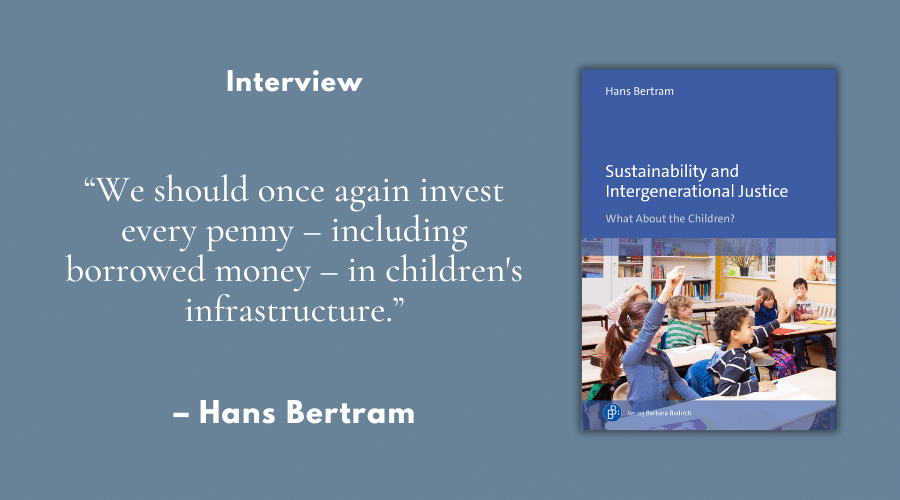
Today’s children are being left behind in the policies that will determine their future. The publication “Sustainability and Intergenerational Justice. What About the Children?” by sociologist Hans Bertram shows why sustainability and intergenerational justice must become central to political decision-making. Read an interview with Hans Bertram here.
The book has also been published in German under the title “Nachhaltigkeit und Generationengerechtigkeit: die vergessenen Kinder”.
Professor Bertram, in your introduction to Sustainability and Intergenerational Justice, you refer to Karl Mannheim’s argument that every generation is responsible for renewing society and therefore also bears responsibility for the conditions in which future generations will live. Against this background, could you summarise the central criticism of your publication?
How can today’s generation fulfil its responsibility to leave children fair opportunities for the future when politics and society have come to reduce sustainability almost exclusively to climate protection, while neglecting equally fundamental areas of life such as education, health and poverty reduction?
How do you develop this critique?
With the support of the overwhelming majority of its member states, the United Nations has formulated 17 Sustainable Development Goals, creating a framework for collecting comparable data across the countries that have committed themselves to these goals. For children, these data are managed by UNICEF, making it possible to compare developments in Germany, which has also committed itself to the Goals, with developments in other countries.
What do you see as the most significant failures of German policy with regard to intergenerational justice? When did these failures largely occur?
Although the number of children has risen significantly since 2010—partly because of higher birth rates and partly as a result of immigration—the ministries concerned continued to calculate child population figures on the basis of the weakest birth cohorts. The consequences were entirely predictable: by 2025, almost two million more children were living in Germany than had been forecast. This means that a foreseeable shortage of teachers has emerged in nurseries, kindergartens, primary schools and secondary schools alike. Based on current figures, a rough estimate suggests that Germany is short of around 110,000 teachers, a further 45,000 teachers specialising in German as a foreign language, and approximately 12,000 to 15,000 social workers. All of this comes at a time when children from increasingly diverse family backgrounds are presenting teachers with entirely new challenges.
You describe developments in Germany as paradoxical in areas including education, poverty reduction, health and security systems, as well as equality and climate policy. Could you illustrate one of these paradoxes with a concrete example?
Twelve per cent of children live in households receiving Citizens’ Benefit (Bürgergeld). Among people aged over 65, the figure is only 4 per cent. Around 11–12 per cent of children leave school without any formal qualification, whereas among those over 65 the proportion is around 3–5 per cent.
Government-appointed pension commissions argue that mothers should participate fully in the labour market in order to keep pension contributions as low as possible. At the same time, they know perfectly well that women in full-time employment in Germany—much like in Japan—have fewer than one child on average. In order to preserve the current generation’s standard of living, the pension commission is effectively proposing to undermine the pension system of the grandchildren’s generation.
All of these figures are publicly available. Hardly any other European country shows such pronounced differences in the language development of children from different ethnic backgrounds as Germany does.
Climate policy, meanwhile, passes both the consequences of climate change and the associated costs on to consumers. This is a legacy of the neoliberal credo of the 1990s. As a result, a homeowner in the suburbs of a major city can heat and cool their home cheaply thanks to solar panels and drive an electric car. By contrast, a family with two children living on a housing estate on the outskirts of the same city can only dream of these advantages, because electricity and heating costs remain heavily taxed.
Which of the shortcomings you have identified could be addressed most quickly, assuming there were sufficient political will?
We should simply take inspiration from the 1970s and 1980s. Conservative-led states such as Bavaria and Social Democratic-led states such as North Rhine-Westphalia invested every available penny in opening up secondary education. Whether they ultimately succeeded or not is another question.
Today, we would not need extraordinary measures to secure the pension system; people could simply work for longer. After all, we are much healthier today than our parents’ generation was.
We should once again invest every penny—including borrowed money—in children’s infrastructure while at the same time making the professions of early years educators, teachers and social workers more attractive than any other occupations in the public sector.
And which shortcomings are the most urgent?
That question has essentially already been answered by the previous one, and the solution would actually be quite straightforward.
In your introduction, you point out that states have agreed on the United Nations’ 17 Sustainable Development Goals, thereby committing themselves not to restrict the opportunities for action and development available to future generations. What trends can be observed in other European countries?
The Polish border lies only around 90 to 100 kilometres from Berlin. Poland has achieved remarkable progress in the PISA assessments. Child poverty has fallen significantly, demonstrating that it is possible to improve children’s living conditions even under difficult political circumstances.
Countries such as Spain, meanwhile, show that sustainable economic development and affordable electricity can go hand in hand, while also creating new industrial jobs.
Even more interesting in this context, however, are Asian countries such as South Korea, Japan, China and Vietnam. There, educational research and the social sciences are actively engaging with the new challenges posed by technological development, and this is already having consequences for schooling and child development.
About Hans Bertram
Hans Bertram was Professor at the University of the Bundeswehr Munich, Director of the German Youth Institute in Munich, and Professor at Humboldt University of Berlin. He is a member of the German National Academy of Sciences Leopoldina. In his advisory capacity, he contributed to the German Federal Government’s Child and Family Reports and, for twenty years, reported on the living conditions of children in Germany on behalf of UNICEF.
Order “Sustainability and Intergenerational Justice” in our shop or download as e-book
Sustainability and Intergenerational Justice.
What About the Children?
by Hans Betram