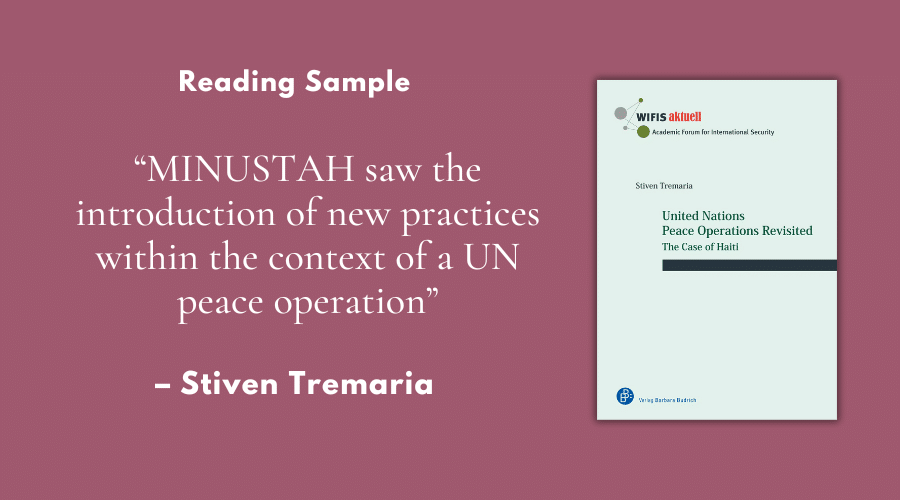
Can the use of coercive force by UN peace operations truly produce stability when confronting armed non-state actors? Where does stabilisation end and the erosion of peace begin? The publication “United Nations Peace Operations Revisited. The Case of Haiti” by Stiven Tremaria critically revisits the rationale and performance of such operations, using Haiti as an extreme case study. With its long history of UN peace engagement, ongoing challenges, and uncertain future prospects, Haiti offers a revealing lens through which to examine this enduring paradox. We provide a reading sample of the publication “United Nations Peace Operations Revisited” here.
Chapter 4, pp. 32 – 34
4.1 The United Nations Stabilization Mission in Haiti
The UN Stabilization Mission in Haiti (MINUSTAH, by its French acronym) was the first ever UN stabilization mission and the longest and largest peace operation to date in the history of its engagement with Haiti: lasting 13 years (from June 2004 to October 2017), composed at its peak of 2,366 soldiers and 2,374 police officers – from 19 countries in total, under the command of Brazil – and 304 international civilian personnel. Set up by UNSC Resolution 1542 on 30 April 2004 to address and manage the social chaos unleashed after Aristide’s forced departure from power, MINUSTAH’s stabilization mandate is quite extensive and comprises two dimensions: on the one hand, ensuring, through its military component and all available capabilities, a secure and stable environment, the extension of state authority throughout Haiti and the restoration and upholding of the rule of law and public order to enable the resumption of a political and constitutional process; and, on the other, the reform, reorganization and training of the PNH as well as the disarmament, demobilization and reintegration of armed non-state actors by the police and civilian component.
It follows that the mandate given to MINUSTAH, while quite ambitious in its aims of stabilizing the country and restoring government authority and social order, lacks clarity regarding the means and boundaries. Therefore, MINUSTAH was entrusted in loose and diffuse terms with broad goals under a clear security-first approach, only stipulating in a short but vague sentence that the mission could use all its capabilities to achieve them – without expressly authorizing the use of coercive force. This instance is emblematic of a certain caution within the UNSC in the early 2000s to openly mention in its resolutions about consent to use force for stabilization purposes under Chapter VII powers, while leaving the door open to every possible option, which De Coning (2008: 87) refers to as “constructive ambiguity.”
Owing to a severe deterioration in the security situation in the country and the credibility of the mission to address it after its first year of deployment, MINUSTAH “saw the introduction of new practices within the context of a UN peace operation, namely the use of joint military-police forces to conduct offensive action against armed groups that were labelled as ‘gangs’” (Pingeot 2018: 365), and therefore, decided to embark in late 2004 in gang-clearing operations to counter the chimès and rural militias through employing high intensity lethal force. This the consequence of the uncompromising stance by the Préval government, which after failed attempts at negotiation declared that “the gangs must ‘disarm or die’,” thus giving the green light for the Haitian army and police to launch an armed campaign of extermination against gang leaders and to take back control of gang-held areas by force (Dorn 2018: 129, Cockayne 2014: 750). MINUSTAH joined these endeavors in a combative stance by conducting a series of air and ground military raids in Port-au-Prince shantytowns (above all in Cité Soleil and Bel Air), taking place between 2004 and 2007, which actually became the very core of the mission’s activities (Dorn 2009: 818). These operations clearly positioned MINUSTAH in a warring position against gangs as targeted enemies, which is the outcome of a criminalization of the Haitian conflict caused by a discursive shift from politically motivated to criminally motivated violence (Schuberth 2015: 177), as the gangs became “a threat to the stability of the Haitian state, and therefore to broader international peace and security – and MINUSTAH simply adapted to this reality […] in a context of simultaneous wars ‘on terror’ and ‘on drugs’” (Pingeot 2018: 367). Consequently, under new discourses on the international arena after 9–11 and a crime-conflict nexus approach for UN peacekeeping practices, the labelling of the gangs as peace and security aggressors altered MINUSTAH practices of intervention, and legitimized its loss of neutrality relative to the Haitian conflict parties and the adoption of militarized approaches to deal with the gangs through the use of coercive force (ibid.: 368).
MINUSTAH engaged in a relatively successful manner in these highintensity counter-gang operations, largely because it enjoyed vigorous political and financial support from UN headquarters, as well as operative and tactical capabilities in-situ after a significant increase in the mission’s strength and the creation of a “rapid reaction force” to more effectively ensure public security and order, particularly in and around Port-au-Prince (UNSC Resolution 1608 on 22 June 2005). Following an initial phase with substantial operational, tactical and strategic flaws, MINUSTAH achieved in a quick and short period of time to build and put together a well-equipped, competently led, well-integrated and highly capable multinational forces, particularly from the Brazilian contingent, that included many officers with broad experience and know-how in dealing with criminal gangs in the favelas (Cockayne 2014: 746). During these raids, MINUSTAH made use of a wide range of resources in a coordinated manner to maximize the effectiveness of operations and minimize damage, including the combination of aerial and infantry power, transversal coordination and integration between police and military components, the use of combined instruments of intervention comprising military raids together with strong law enforcement powers by Formed Police Units, the use of diversionary tactics to create confusion among the gangs, the employment of night vision and infrared capabilities, snipers and unmanned aerial vehicles to drop leaflets warning civilians of the impending attack, the integration of PNH squads for providing assistance through cordon and crowd control, and the establishment of safe corridors for Red Cross mobile units to assist the wounded (Cockayne 2014: 754, Pingeot 2018: 376–378, Dorn 2018: 134–136).
Key to the fruitful planning, management and conduct of counter-gang operations in Cité Soleil and Bel Air was the development of a comprehensive and multilayered mission’s intelligence capability through human and technological assets. Over time, MINUSTAH evolved to a well-planned, focused and limited use of force by the adoption of criminal investigation techniques through a Joint Mission Analysis Cell (JMAC), which by making use of generated human intelligence through a network of local informants allowed for a careful preparation of operations. The intelligence furnished by the JMAC – in support of the PNH – relied heavily on treating the local population as key terrain for gaining key data through a toll-free 24/7 hotline to confidentially share information on gang routine activities, and a paid network of local informants (Dorn 2009: 821–822). Largely, “MINUSTAH was also able to purchase information, in part because the inhabitants of Haiti’s bidonvilles are so poor that the price of such information was low enough to be within the very limited means available to the JMAC, and below the level that would have triggered political scrutiny and interference from its backers” (Cockayne 2014: 760). Likewise, the JMAC substantially developed with appropriate technological tools highly valuable imagery intelligence via aerial photography of defensive trenches, resupply and repair positions, weapons caches, stores of loot, command headquarters, sleeping locations and escape routes, which allowed a better preparation of the battlespace and running of operations (Dorn 2009: 823–824). Besides these operational measures, MINUSTAH also pioneered the institutionalization of intelligence structures within the mission headquarters and nationally, in tandem with the regional battalions of the national contingents, but also externally by liaising closely with the UN operations center and collection analysis units (ibid.: 830–831).
***
Would you like to continue reading?
Order “United Nations Peace Operations Revisited” in our shop or download as e-book
United Nations Peace Operations Revisited
The Case of Haiti
by Stiven Tremaria
Interested in more readings samples and interviews? Have a look at our blog.