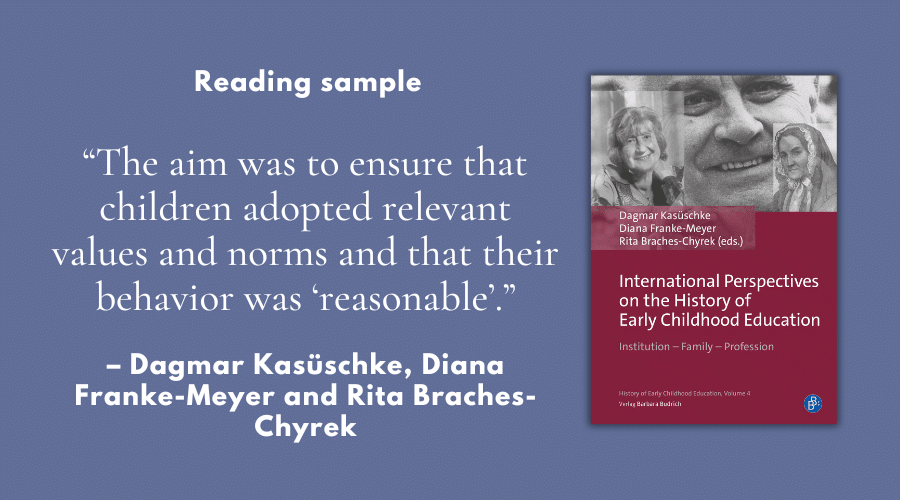
How did child protection in families come up, how did institutionalized child protection develop? Which historical narratives and conjunctures played a role for the development of child protection? Find a reading sample from the volume “International Perspectives on the History of Early Childhood Education“ here. We are sharing a snippet from from the chapter “The History of the Research Field of Child Protection“ by Rita Braches-Chyrek.
Reading sample from the chapter “The History of the Research Field of Child Protection“, pp. 157–161
Care and protection of children in families
The demand that children have an “inalienable right” to “childhood” and “protection” emerged as early as the 18th century (ibid., p. 32; Cunningham 2006, p. 227; Heywood 2010, p. 144). The vehemently demanded protection for children’s lives was based on the perception and classification of children’s actual, albeit time-typical, life situations (ibid.; Marten 2018, p. 50; Berrick et al 2023, p. 2). The central assumption was that a “good upbringing and education of children could shape them into “moral” and “useful” people so that they would have a lasting benefit for society and its continued existence (Berg 1991, p. 25ff.; Heywood 2010, p. 62).
The reduction and avoidance of risks, such as unfavorable influences from the environment and the family or those responsible for raising the children, early integration into work processes or military service became important social tasks. At the same time, however, it was also important to ensure the most effective and sustainable socialization of children into the family and society. The aim was to ensure that children adopted relevant values and norms and that their behavior was “reasonable” (Heywood 2010, p. 62; Martens 2018, p. 50). These first forms of explaining, understanding and formulating considerations for changing and developing family socialization, upbringing and educational processes initiated comprehensive processes of social order formation, the aim of which was to create universally valid protective and caring environments for all children (ibid.; Jacobi 2014, p. 25; Franke-Meyer 2011).
At the same time, debates about alternative knowledge systems were promoted (Heywood 2010, p. 72). Reflections on children’s rights to participation and involvement emerged, for example in Thomas Spence’s work “The Rights of Infants” (1796). This enabled new cultural and social emphases to be placed on the care, protection and establishment of children’s rights and policies (Cunningham 2006, p. 192). The emergence of pedagogically legitimized, state-supported and promoted models of care and protection orders at the end of the 18th century was a consequence of these developments. Ensuring child protection became an important social task (Heywood 2010, p. 72; Jacobi 2014, p. 25). Empirical findings on the health restrictions and low life expectancy of children due to family care, upbringing and educational practices as well as their strong involvement in work processes were used to legitimize the protection of children institutionally (Addams 1907; Duncker 1910; Pollok 1983, p. 42; Berg 1991, p. 24ff.; Schmid 2014, p. 46ff.). In the following, the establishment of care relationships and protective measures are outlined using the example of the low life expectancy of children and the prohibition of child labor.
- the low life expectancy of children could already be proven by empirical findings, such as statistics on mortality rates, in the 18th century. However, the health impairments of children and infants of all social classes due to inadequate care were also increasingly addressed (Addams 1907; Cunningham 2006, p. 217; Heywood 2010, p. 145; Schmid 2014, p. 47). These included family practices such as the abandonment of infants, wetnursing and child abandonment, which were widespread (de Mause 1977; Jacobi 2014, p. 25). A variety of causes led to these precarious practices, such as insufficient family resources and medical knowledge, hygienic, social and moral deprivation. Infant mortality was particularly high in the poor and working-class neighborhoods of expanding industrial cities in Europe due to socio-economic conditions such as a lack of supervision, inadequate occupational health and safety measures and difficult sociospatial conditions (Thompson 1987).
- Accidents, inadequate nutrition and poor living conditions contributed significantly to the low life expectancy of poor children. In some cases, very distanced forms of parental interaction with their children can be demonstrated, as evidenced by the practice of swaddling or sedation with alcohol or opium (de Mause 1977; Calvert 1994, p. 21, p. 77). However, the conscious or unconscious neglect of children and the subordination of children’s needs to family necessities in terms of their “work value” were also widespread. Family practices also threatened the lives of children who were considered ‘essential’ for the survival of the family, such as abortion, abandonment, abandonment to other families (see, for example, the “Verdingkinder system”), the sale of children as slaves and various forms of sexual exploitation (Aries 1978; Cunningham 2006; Hommen 1999; Marten 2018, p. 51). Also worth mentioning in this context are family strategies to secure succession and inheritance, which can lead to very drastic forms of child neglect, abandonment or even killing, as documented by the widespread femicides (Hommen 1999).
- particular attention was paid to the sometimes very drastic exploitation of children through child labor (Duncker 1910). There is evidence that children in Western Europe contributed to the livelihood of their families by being involved in work processes long before industrialization (Addams 1907; Richmond & Hall 1913, p. 30; Kucynski & Hoppe 1958). In the crafts, trade, mining, textile and hospitality industries as well as in agriculture, it was taken for granted that children worked (Cunnigham 2006, p. 161ff.). They performed tasks as servants, apprentices, day laborers, supervised and cared for their siblings and elders, were given to other families and large farms as workers or contributed to the family’s livelihood through their work in spinning and weaving mills, mines and factories. The involvement of children in the work processes varied greatly depending on the number of siblings, gender and position in the family, as well as the family hardships to be overcome. Particularly in the increasingly capitalized industrial societies of Western Europe, forms of massive and exploitative child labour manifested themselves over centuries in various industrial and service-related sectors (Pollok 1983, p. 62; Cunnigham 2006, p. 182).
It can be noted that child labor promoted industrial growth and wealth (Mas 2018), while at the same time massive social problems arose, as the working children often had only a minimal education and the hard industrial work led to multiple health problems (Braches-Chyrek 2013, p. 139; Cunnigham 2006, p. 186). Although attempts were already being made to restrict child labor in pre-industrial times, e.g. “landlords” were obliged to care for those dependent on them, it was not until 1839 that the Prussian Regulatory Act introduced legal regulations to restrict child labor. Towards the end of the 19th century, comprehensive efforts were made on the European continent to formulate universally applicable child protection laws (Duncker 1910; Engels 1845; Feldenkirchen 1981, p. 2). In 1904, a child protection law was passed in Germany, which restricted child labor in many industrial sectors.
These early discussions and empirical research into the reasons for the low life expectancy of children as well as the introduction of social and political measures to prevent poverty, the establishment of comprehensive education, training and health programs and initiatives to restrict child labour were accompanied by increased social debates on child protection. Attempts were made to address the conflict between societal demands, family requirements to secure subsistence and children’s needs for education, play and recreation and to establish new patterns of order. The scientific studies mentioned here promoted public and political debates on the extent, causes and effects of a lack of child protection and child labor (Engels 1845; Duncker 1910; Feldenkirchen 1981, p. 2; Berg 1991, p. 23).
As part of welfare policy efforts, these led to the expansion of welfare, to educational initiatives (Franke-Meyer 2011) and to the enforcement of the ban on child labor. However, the scientific and practical debates about the different restrictions on child development and education due to inadequate child protection also point to the power imbalance between adults and children and between rich and poor (Braches-Chyrek 2013, p. 139; Braches-Chyrek 2021; Cunningham 2006, p. 165). Childhood was not a protected space; through early involvement in communities and work processes, children were to develop attitudes, behaviors and skills that were considered exemplary (Berg 1991, p. 25). Education for usefulness, modesty and aspiration was long regarded as ideal (Mas 2018). This clearly shows that the thematization of child protection was subject to the very different dynamics of social, political and economic structures and that the increase in social sensitization and perception processes shown here with regard to the recognition and consideration of children’s needs and concerns developed only very slowly.
***
Would you like to continue reading?
Order “International Perspectives on the History of Early Childhood Education” in our shop or download as e-book

International Perspectives on the History of Early Childhood Education
Institution – Family – Profession
edited by Dagmar Kasüschke, Diana Franke-Meyer and Rita Braches-Chyrek
Interested in more readings samples and interviews? Have a look at our blog.