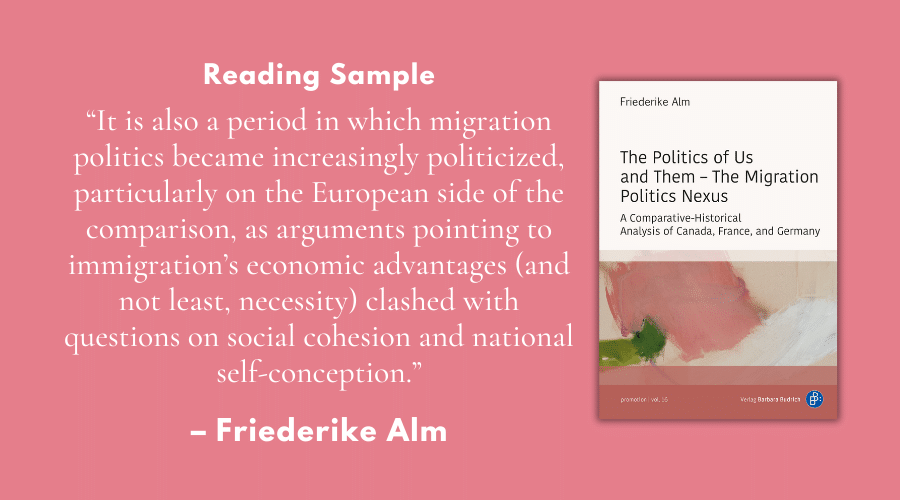
How did migration politics develop in Germany, France and Canada? What are the differences and how did the countries’ approaches change over time? With “The Politics of Us and Them – The Migration Politics Nexus” Friederike Alm presents a comparative-historical analysis which sheds light on the historical trajectory of migration politics in Canada, France and Germany since 1945. The author proposes a new concept for migration research, the migration politics nexus, which highlights the interconnection between immigration, citizenship, and integration politics. From the book “The Politics of Us and Them” you can now find a reading sample here!
chapter 6, pp. 171 – 175
6. ‘Who are we? Who do we want to be?’: Mid- to late 20th Century Migration Politics in Canada, France, and Germany
6.1 Introduction
We continue our analysis into the latter half of the 20th century, encompassing the 1960s to the 1990s, when all three countries experienced political change and turmoil, and, as a result, significant shifts in their migration politics. During the two decades of economic prosperity that followed the end of WWII, Canada, France, and the Federal Republic of Germany (at first only comprising the West, later united with East Germany), established themselves as influential democracies. All three experienced ever-heightening immigration numbers with the origin countries of those immigrating diversifying as well. It is in this period that migration politics became established as a permanent feature of everyday political life in all three countries. It is also a period in which migration politics became increasingly politicized, particularly on the European side of the comparison, as arguments pointing to immigration’s economic advantages (and not least, necessity) clashed with questions on social cohesion and national self-conception. On the North American side of the comparison, questions on national unity also emerged, not only regarding immigration but also in relation to Canada’s province Quebec, which laid claim to specific forms of recognition within the Canadian federation. This tension and its results would have unexpected effects on migration politics as they are conceived in this thesis. In short, migration politics became part of larger questions concerning the self-conception of each country, processes that each case underwent albeit at different points in time.
This chapter traces these developments in a complex analysis. For Canada, I delve into the period between 1962 and 1988, encompassing more than 20 years. It was in this time that Canada developed an elaborate migration politics nexus with clear interactions between immigration and citizenship politics, and a state approach to integration politics in the form of multiculturalism.
In France, the examined period between 1974 and 1993 shows equally complex developments. Spanning from the immigration stop in 1974, this period sees a significant tightening and eventual abandonment of France’s status as an immigration country. On the level of citizenship politics this is reflected also, when historically liberal principles for naturalization and citizenship acquisition are put into question, particularly regarding France’s growingly diverse immigrant population and their children. The latter issue is cause for a significant politicization of migration politics, emerging in the 1980s and remaining constant even until today. Falling on fertile ground, a newly established far-right party, the National Front, succeeds in growing on a single-issue: anti-immigration demands in the 1980s, also called the “Lepenisation” (Raissiguier 2010: 80), after their infamous party leader Jean-Marie Le Pen, of these political issues. To understand these developments, it is again necessary to take France’s colonial history into account. Decolonization brought with it fraught questions about the political status of those stemming from former colonies and their children now living in France. No issue had more pertinence for France’s immigration, citizenship, and integration politics during this period than immigration from formerly French-colonized Algeria, as this chapter will show.
The analysis in Germany begins a little later, with post-unification developments in the Federal Republic. A belated reckoning with the established presence of immigrants in the country, which had increased throughout the 1960s and 1970s, led to a decade of migration politics turmoil in the 1990s. Saliently, this is when Germany abandoned its prioritization of co-ethnic immigration, leading to a significant shift in its migration politics nexus. These developments eventually led to a liberalization of citizenship politics in 1999 with the official introduction of ius soli, a precursor to new immigration and integration politics innovations in the early 2000s.
6.2 Canada – Paradigmatic Transitions to Establish Cohesive Migration Politics, 1962–1988
In this chapter, I argue that Canada underwent a critical juncture in migration politics from 1967 to 1982. The legacy of these paradigmatic developments is felt until today. This critical juncture is framed by complex and intricate developments in the 1960s, 70s, and 80s, spanning four different governments, and mark the foundation of Canada’s migration politics as they continue to this day.
The shifts in these periods begin with immigration politics: In 1962, Canada first dropped religion and race from its immigration criteria through an executive order-in-council. This chapter traces the consequences of this rupture, like the introduction of points system for immigrant selection in 1967, and a new Immigration Act in 1976, including the tripartite division of immigration in professional / work immigration, family-class immigration, and humanitarian immigration that further propelled Canadian immigration poli- tics to the center-stage of Canadian policymaking. In the 1960s, Canada was experiencing increasing tensions with Quebec, which meant that PM Pierre Elliott Trudeau introduced multiculturalism as an official state doctrine in the Canadian House of Commons in 1971, which was followed by the adoption of multiculturalism as official state doctrine 1982 in the Canadian Charter of Rights and Freedoms, further entrenched in the Multiculturalism Act passed in 1988. This period also marked the beginning of the federalization of Canadian immigration politics, beginning with Québécois particularism in the 1960s.
6.2.1 No more race, no more religion, 1952–1962
A Canadian expert who served as a public servant in migration politics from the late 1960s onwards offered a lively description of the developments that shaped the 1960s and led to the conservative government dropping race and religion from their immigrant selection criteria:
And then when the first conservative government of John Diefenbaker comes in – remembered for being a cantankerous and miserable old son of a b (sic), but one of those people who hates people but loves human rights ((laughs)), you encounter them – he brings in a Bill of Rights, but it only applies to federal jurisdiction. But they look at it, they look at the immigration law for 1951 and Ellen Fairclough, the first female cabinet minister, is given the job doing something, she wants to change the Act. Nobody wants to open the Immigration Act. So, they bring in the famous 63 regulations, except with a few small exceptions say (…) you’re no longer to consider race and religion here. Do they have the skills and the education, language to make it in Canada? If so, you can let them in. But they provide no other guidance. So, it’s hard to explain what’s going on. (CPS6: pos. 26)
As chapter 5.2 on the Canada’s postwar critical juncture showed, the central legacy of the immediate postwar years in Canada was the development of a confident Canadian self-conception independent from Britain. As the same expert interviewee put it aptly: “The real history of Canada in the 50s and 60s in particular is becoming Unbritish” (CPS6: pos. 18, italics by FA)[1]. At the end of the 1940s and throughout the 1950s, under Liberal PM Louis St. Laurent, Canada ramped up its immigration numbers to bolster its labour force. Most immigrants came from Europe, as this was still the desired origin in Canadian immigration. Most, however, did not come from the United Kingdom or France, but from Italy, Portugal, Greece, or Hungary. This led to an increase in immigrants (and eventual Canadians) of non-French, non-British origin, marking the beginning of a transformation of the overall composition of Canadian society.
The approach of selecting by European origin was met with only modest criticism domestically. In fact, surveys at the time revealed that the Canadian public held “deeply ambivalent, if not unequivocally racist, attitudes towards the admission of non-European immigrants” (Ellermann 2021: 202). These data were confirmed by the personal experience of one of the expert interviewees who pointed out that “coming to Canada in 1950 was a harrowing experience. I mean it was truly a racist country and this racism continued even though laws were passed on anti-discrimination and fair practices” (CAC4: pos. 22).
However, change was on the horizon. In 1957, conservative John Diefenbaker, the first Canadian PM of neither French nor British descent, was elected. Also referenced in the quote above, Diefenbaker was deeply committed to anti-discrimination due to his own experience growing up in the Canadian prairies and experiencing discrimination of French Canadians and Indigenous Canadians first-hand (Carlson 2012). He introduced the Canadian Bill of Rights and is credited with ushering in the first significant reform of the Canadian immigration system since 1952, the 1962 rupture, which sparked the coming critical juncture. In this 1962 amendment to the 1952 Immigration Act, neither race nor religion were to be considered when evaluating a candidate seeking immigration admission.
The introduction of the 1962 immigration regulations reformed the 1952 Immigration Act short of abolishing it. In fact, sparking fundamental policy change through a regulatory reform is a typical pattern for the Canadian case, as one expert interviewee stressed (CAC5: pos. 13). I am not alone in the argument that the 1962 regulations constituted a rupture. Ellermann has also called the introduction of the 1962 regulations the “paradigmatic watershed” or “turning point” of Canadian immigration politics, which “sounded the death knell for the White Canada policy” (Ellermann 2021: 195), while Fleras has called their introduction a “radical change” (Fleras 2015: 91).
The new regulations put an emphasis on skills and excluded race or religion as selection criteria for potential immigrants. To be sure, the introduction of the 1962 regulations were not only based on a normative desire for anti-discrimination. As time progressed, the number of potential immigrants from preferred origins was becoming limited (Triadafilopoulos 2012: 88). The exclusionary approach of the 1952 Act therefore also became pragmatically untenable if Canada wanted to maintain its immigration numbers, as well as increasingly normatively untenable in light of the Canadian Bill of Rights as Canada’s democratic self-conception.
Concomitantly to the changes that were occurring on the immigration level, the Canadian government was grappling with a threat to social cohesion, which initially had no explicit connection to migration politics but would have a remarkable effect on the eventual development of multiculturalism: The enduring threat of Québécois separatism. PM Diefenbaker had domestically pursued a ‘One Canada’ policy, which meant that he opposed any political concessions to Quebec, fearing that this would entrench the idea that Canada was home to only two major founding powers, the British and the French. With few Québécois members of Cabinet and little sympathy from the Conservative PM, the tension between the federal level and the province increased throughout Diefenbaker’s 1957–1963 term. As a result, the Progressive Conservative party lost ground in Quebec, leading to Diefenbaker’s electoral defeat in 1963. He was succeeded by Liberal PM Lester B. Pearson, who pursued a different approach, as the next section will show.
[1] The expert interviewee referenced a close colleague he had worked with, who said this. Since I think this would be important to the expert, I’d like to add this caveat while still maintaining anonymity.
***
Would you like to continue reading?
Order “The Politics of Us and Them” in our shop or download as open access
The Politics of Us and Them – The Migration Politics Nexus
A Comparative-Historical Analysis of Canada, France, and Germany
by Friederike Alm
Friederike Alm’s dissertation was awarded the Budrich Dissertation Prize promotion.
Interested in more readings samples and interviews? Have a look at our blog.