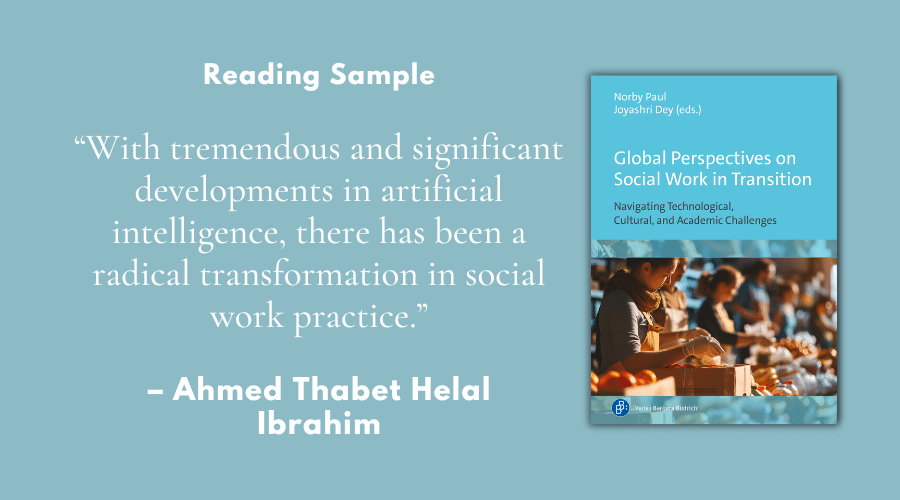
Social work has focused on using technology for social good, emphasising the important role of technologies in education, practice, and training. Rapid advancements in artificial intelligence underscored the increasing necessity of integrating AI into different fields. Learn more about the reshaping of social work in the AI Era and read our sample from the volume “Global Perspectives on Social Work in Transition” edited by Norby Paul and Joyashri Dey.
Reading sample, pp. 109–113.
Reshaping Social Work in the AI Era: Implications for Tomorrow’s Practice
Ahmed Thabet Helal Ibrahim
Introduction
The social work field has a long and detailed history of dealing with technology. The first scientific paper appeared in February 1970, concerned with social +work’s response to an interest in technology. From the beginning of the 1970s to the end of twentieth century, the field was fully preoccupied with how technology was used in the teaching and practice of social work. Theron K. Fuller authored the first paper on the importance of technology in social work. It was published in the Journal of Social Casework, which was called at the time “Families in Society. The paper advocated the use of computers in social work, as they can maintain a large number of files. It also stressed the need to accelerate social workers’ use of AI in their professional practices to make effective decisions for clients, prevent duplication of services, and increase the number of cases they can handle (Fuller, 1970).
Advancing technical, especially during the second wave of technological advancement in the field of artificial intelligence, has greatly changed social work practices and education (Bidwell et al., 2023). Artificial intelligence (AI) has provided new ways for education and practice as well as essential support for social workers in dealing with social problems. AI is one of three major approaches to addressing climate change and the promoting a just and equitable society (Mintz et al., 2018). McMurtrie (2023) believes that AI will play a crucial role writing process. Therefore, Sharples (2022) recommends engaging students and teachers with these tools to facilitate learning rather than prohibiting them. This chapter explores the historical development of technology in the field of social work, from the introduction of computers in professional practice to the artificial intelligence revolution. It also addresses the mechanisms for integrating artificial intelligence techniques into the education and practice of social work, as well as the difficulties that prevent the use of these techniques, with reference to recommendations that would enhance their use in social work.
1. Historical Origins of the Use of Technology and AI in Social Work
The field of social work has a reputation for being anti-technological, and it tends to adhere to the traditional model of working with clients. However, with each innovation, social work begins to consider the challenges and opportunities that arise. This shift occurred at the beginning of the twentieth century when the telephone became widely available and was used as a tool in crisis intervention and social counselling. A similar shift occurred at the end of the century when personal computers became widespread, prompting social relief workers worldwide to consider their potential implications for daily work. These computers were not what they are today; they huge machines with little memory, floppy disks, and single-colour that buzzed all day. Of course, there were concerns privacy loss and erosion of face-to-face communication, but there was also enthusiasm because information could be easily accessed when social workers used these technologies. (Glastonbury, 1985; Steyaert, & Gould, 2009).
In 1985, several small initiatives explored such challenges and opportunities. In the United States, Dick Schoech launched the first issue of Computers in Human Services with support from people like Walter LaMendola. This was an expansion in the use of computers in human services. The journal’s name was later changed to Journal of Technology in Human Services (Steyaert, 2013). In 1985, Bryan Glastonbury published his book Computers in Social Work in the United Kingdom. Along with others such as the Dutchman Hein de Graaf, the British Jackie Rafferty, the Canadian Rob MacFadden, and the Belgian Jan Steyaert, launched two projects (Glastonbury, 1985). The first was technology applications in human services projects, and the second was the European Network for Information Technology and Human Services. They also organised a series of international and European conferences annually (Schoech, 1999). Moreover, the American magazine “Computer Applications in Social Work”, based in the United Kingdom, was launched. It was later renamed “New Technology in Human Services” and discontinued in 2003 (Mendola et al., 1986).
By the end of the twentieth century, technology and its relationship to social work had changed radically. It had become easier to use, cheaper, and more powerful due to the widespread availability of the internet in homes. The relationship between technology and social work has evolved in two ways.
- First, there were fears of a digital divide in which individual ownership of computers and home internet access would create new social inequalities. Community technology centres and public libraries have attempted to counter this issue.
- Second, the focus was on what citizens would do at home with this technology. With the advent of Web 2.0, interest in the part of citizens’ interest in searching for information sources (such as Wikipedia) and building social networks (such as Facebook and Twitter) also increased. Questions began to arise: Would these changes lead to an increase in social quality or would they signal the erosion of social capital? During this period, social workers were interested in using computers for professional tasks because of their easy access to them. Computers were not only used for routine office work, such as typing documents, but also for support online consultations and maintaining client records (Steyaert & Gould, 2009).
In mid-2017, the National Association of Social Workers (NASW), in cooperation with the Council for Social Work Education (CSWE), issued the “Technology in Social Work Practice Report”. It addressed social work institutions’ interest in employing digital technologies to teach and practice social work. That report indicated that technological advances had changed social work practices and greatly expanded social workers’ ability to help those in need. Technology has enabled social workers to offer professional benefits by leveraging current technological developments.
Digital social work has become important as it provides an opportunity to strengthen the role of social care providers in addressing emergencies and challenges arising from the pandemic in today’s digital society. (Pelaez et al., 2018). Furthermore, researchers have stressed the need to highlight the nature of electronic social work to facilitate the process of interventions and better understand the role of technology in this field (Pelaez et al., 2018).
Technologies such as deep neural networks and machine learning have increased interest in artificial intelligence. AI allows for amazing achievements such as self-driving cars, natural language-speaking systems, recommendation systems, assisted medical diagnosis, and intelligent robots. Artificial intelligence is a developing field of computer science that enables technical systems and programs for perform tasks requiring, intelligent, human-like thinking. This field strengthens various other fields and sectors, including finance, education, healthcare, transportation, and social work. It aims to create systems of learning information and structured logical thinking that rely on laws and principles of logic to make decisions and solve problems. In addition, many tasks that typically rely on human cognitive abilities are now performed using artificial intelligence algorithms and models, enhancing machines intelligent and autonomy (Mhlanga, 2023).
Pretrained transformers are a type of deep learning model that rely on the self-attention mechanism and differentially weigh the importance of sentence data. This model takes a group of natural language sentences, changes them into symbols, and then predicts the conditional possibility of the next symbol. When the symbol is generated, it is added to the end of the input sequence (for example, adding extra words to the string of sentences entered into the model). As these prediction laps continue repeatedly, the model can complete an incomplete sentence, add extra information to a sentence, or even create an entire paragraph based on simple sentences. Pretrained transformers are targeted at handling natural language tasks such as translation, text summarisation, and text modification. Google introduced its first transformers model in 2017 (Brown et al., 2020). Chatbots have been used to assist customers and service recipients for several years. The capabilities of this model became widely recognized with the launch of the ChatGPT model by OpenAI on 30 November 2022. ChatGPT is a generative language model; it has been trained on nearly 300 billion words, giving it the ability to speak on a wide range of topics (Eysenbach, 2023)
Teubner et al. (2023) highlighted ChatGPT as a significant marker of the cognitive revolution in AI, noting its rapid adoption with 1 million users in five days and 100 million in two months, compared to Instagram and Spotify, which took much longer. Similarly, Okonkwo and Ade-Ibijola (2021) discussed the growing use of intelligent chatbots in higher education, particularly ChatGPT.
With tremendous and significant developments in artificial intelligence, there has been a radical transformation in social work practice. This development has encouraged practitioners to rethink social work practices in the digital age. The world is becoming increasingly reliant on technology. Accordingly, a major challenge for the social work profession is how to utilise technological and digital progress to confront and address clients problems.
Facing this challenge will lead to more accurate and well-documented services. These services will benefit clients who receive social care by improving their diagnosis, understanding of their problems, and monitoring their reactions and behaviour.
Moreover, social advantages are now available to those who have traditionally been excluded due to geographical and transportation barriers, as well as other obstacles preventing their access to social workers. With the strengthening of ICT integration, social work has become more widely available and provides its practitioners with the necessary support to enhance and employ technology in professional practice, relying on digital technologies client interventions (Stephanie et al., 2015).
***
Would you like to continue reading?
Order “Global Perspectives on Social Work in Transition” in our shop or download as e-book

Global Perspectives on Social Work in Transition
Navigating Technological, Cultural, and Academic Challenges
edited by Norby Paul and Joyashri Dey