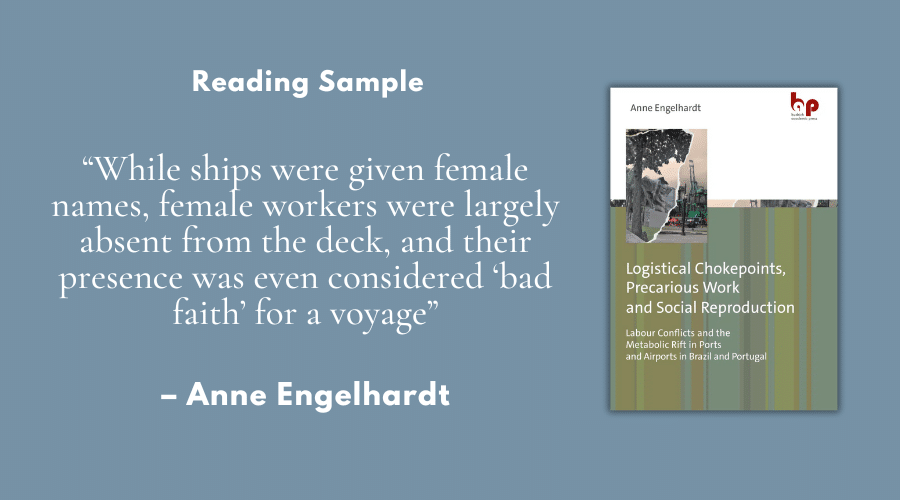
Sitting at pivotal points of globalized economies, workers in logistical chokepoints such as ports and airports should have a lot of negotiating power. Anyhow, their working conditions in ports and airports are still predominantly precarious. Examining the spatial-historical narrative of logistics in Portugal and Brazil, Anne Engelhardt asks in her book “Logistical Chokepoints, Precarious Work and Social Reproduction. Labour Conflicts and the Metabolic Rift in Ports and Airports in Brazil and Portugal” what is behind these patterns. Find a reading sample from chapter 6 here.
Reading sample, pp. 141–143.
6.1 Gendered Segregation in the Maritime and Port Sector
Throughout the history of maritime transport, it has been documented that male workers dominate the sector in workplaces characterised by heavy physical labour, male kinship, entrenched sexist and homophobic jokes and behaviours, substance abuse, and promiscuity (Nelles 2001: 73-74; Queiróz et al. 2015; Queiroz/Lara 2019). These characteristics manifest the horizontal gender segregation in the industry. At the same time, they constitute masculinist exploitation patterns that are particularly evident in the port sector.
In 1993, the Brazilian Port Law 8630/1993 was passed to end the trade union employment monopoly of port workers and break the neat link of male family ties in the docks (Galvão et al. 2017: 155). Before the government implemented this law, the port agency opened an annual season for new applicants to enter the port labour market, supported by their fathers, grandfathers, uncles, and brothers (B46 2018: item 10). This tradition of family recruitment is a feature of several ports in Europe and Latin America. David Nelles (2001: 73-74) explains this family-based connection with the close historical and biographical link between seafaring and dock labour. Towards the end of colonial ports, seafarers were traditionally younger than dockers, unmarried and without families of their own, as work at sea required more time abroad and more constant physical and mental labour (ibid. 66). By the mid-nineteenth century, however, port labour had become more flexible. In addition to heavy cargo, there were lighter and less strenuous tasks for workers who might have been gradually impaired by age, work, and possible illness. The industrialisation of seafaring on the eve of the 20th century broke the generational link between dockers and seafarers. This process created two distinct work sectors and led to the gradual isolation of seafarers (ibid. 66-69). Nevertheless, the older generation of dockers would support their male relatives, if not to become seafarers, then to join them in dock work.
6.1.1 Intergenerational Male Family Ties in the Maritime Industry
One remaining tradition in the organisation of port labour was that of working in “gangs” (McPhee 2006: 156). In a daily routine, the lead worker, who either arrived first at the port or even slept on the waterfront, would choose “his” colleagues, usually around 15 or more, to tow or unload and reload an incoming ship (Tillet 1910: 11-12; B46 2018: item 8). The first workers chosen were brothers, sons, cousins, brothers-in-law, and so on, to ensure the family income and also to ensure that the workers could trust each other at each stage. This tradition explains the intergenerational groups that can still be found in older ports, often accompanied by a closed-shop union policy. Today, almost every dockworker in Santos or Lisbon can point to a colleague who is either a relative or a relative of another dockworker.
Unlike male workers, women always have had a complicated position in the maritime industry. While ships were given female names, female workers were largely absent from the deck, and their presence was even considered “bad faith” for a voyage (Brcko Satler et al. 2020: 61). Only two per cent of workers in the maritime sector are female, with a high concentration on cruise ships, where the majority of crew members are women, and only 0.12 per cent on cargo ships (Kitada/Tansey 2018: 242). In order to increase this percentage, research has been conducted on the obstacles faced by female seafarers. The reasons for this type of research are not so much driven by a gender equality idea (although this is the case for the ITF or the IMO), but the need for more workers for the growing maritime industry. It is estimated that there will be some 140,000 vacancies in the sector worldwide by 2025 (Brcko Satler et al. 2020).
Compared to the sea, the proportion of women working in ports is growing slowly, especially in self-driving lorries, haulage, van and crane drivers, IT, and managerial positions. Women are less present (though not absent) in manual jobs such as lashing and storage. This development points to a future trend of small segregations in port labour between precarious, racialised, and low-paid male manual workers and female so-called high-skilled workers in more secure and well-paid jobs. Globally and historically, the absence and presence of women at sea and in ports has not been a linear trend. In the Soviet Union and the GDR, a much higher proportion of women were seafarers, sailors, and port workers, which may be linked to a more supportive reproductive regime with more flexible childcare and less restrictive laws on marriage and spousal obligations, as well as to adequate training (Geffken 2015: 98; Kitada/Tansey 2018: 243). In addition, the East German state in particular suffered from labour shortages and therefore encouraged and trained women to work in manual and industrial sectors.
In other parts of the world, such as Brazil and Portugal, patriarchal laws, norms and the strong influence of the Catholic Church probably played a crucial role in excluding women from seafaring and port work due to traditional family and gender norms. Federici (2014: 30-31) gives a detailed historical account of how European inland cities gradually excluded female workers from craft, bakery, medical, teaching, and other guilds, and how the Church supported gendered exclusion from productive work. However, there are few historical studies of the development of gender segregation in the maritime sector or port cities. Looking at the emergence of the global labour force may provide some answers to why maritime workers are predominantly male. As Federici (2014; 2020), Moore and Patel (2018), and Linebaugh and Rediker (2007), among other Marxist scholars, point out, the “double free” people did not automatically transform themselves into workers. The state and the church played a crucial role in forcing the dispossessed peasants, who lived as vagabonds, pirates, and outcasts, to sell their labour to the emerging capitalist industries in the cities and allow the metabolism of capital accumulation to work. As Federici (2014: 136-137) points out:
… [T]he introduction of “bloody laws” against vagabonds, intended to bind workers to the jobs imposed on them … and the multiplication of executions. In England alone, 72,000 people were hung by Henry the 15e VIII during the thirty-eight years of his reign. … But the violence of the ruling class was not confined to the repression of transgressors. It also aimed at a radical transformation of the person, intended to eradicate in the proletariat any kind of behaviour not conductive to the imposition of a stricter work discipline.
In England and other emerging European states, prisons and disciplinary houses were built to force people into strict temporal routines (Linebaugh/Rediker 2007: 56). In port cities such as London, male workers were dragged from these prisons directly to ships to perform forced labour as seamen, sailors, and soldiers (ibid. 61). Meanwhile, female workingclass prisoners were sent abroad to the colonies, which needed reproductive bodies to ensure the re-creation of receptacles for labour power overseas (ibid. 57).
Nevertheless, women were not historically absent from ports and maritime industries, quite the contrary (Brandon et al. 2019: 9). In the historic Portuguese Empire, women organised the production and sale of fish and other goods (Abreu-Ferreira 2000: 11). While their male relatives spent weeks and months at sea or even got lost, women represented the permanent labour force as retailers in local and distant markets, transporters of seafood between ports and customers, producers of fishing nets, and more (ibid.). Portugal’s comparatively liberal inheritance laws allowed women workers to inherit and manage smaller vessels on which they did not work but which provided them with an income (ibid. 13). During stormy seasons, ships had to remain in port, while fishermen, and other sailors, their children and the disabled were supported by the domestic and productive labour of their female relatives. In the port of Santos, until the 1920s, women played a crucial role in the production of ropes for ships, winches, and coffee sacks for the export of the state’s most important commodity.[1] When the port was transformed from a colonial to an imperial and industrial port, these types of work and female labour disappeared. However, global transport and the accumulation of organised capital at sea would have been impossible without the steady labour force of female workers in the port (Brandon et al. 2019: 9).
[1] This is well documented in the coffee museum in Santos which I visited in March 2018.
***
Would you like to continue reading?
Order “Logistical Chokepoints, Precarious Work and Social Reproduction” in our shop or download as e-book
Logistical Chokepoints, Precarious Work and Social Reproduction
Labour Conflicts and the Metabolic Rift in Ports and Airports in Brazil and Portugal
by Anne Engelhardt
Interested in more reading samples? Have a look at our blog.