
If justice ignores the destruction of our environment, can it ever truly be called justice? What good is fairness if it leaves behind mountains of waste for future generations? Christian Bauer looks into these questions in his article “Ecofeminism. How Our System Is Devouring Nature, Labor, and Care”, published in the volume “Materializing Fairness. Addressing Gender in Design and Tech” (edited by Julia-Constance Dissel and Melanie Levick-Parkin).
Reading sample, pp. 15–17.
Ecofeminism. How Our System Is Devouring Nature, Labor, and Care, – and What Design Can Do about it
by Christian Bauer
1 John Rawls’ idea of fairness and the ecofeminist concept of justice
Imagine we lived in a world in which everyone had equal starting conditions. This could be described as having equal opportunity. Now, imagine we lived in a world in which all people had secure access to clean drinking water, to shelter that offered protection from climate events, and to a healthy diet. This could be called resource justice. For some, this world is within reach, for others, light-years away. This is what we call social injustice.
The American political philosopher and theorist John Rawls’ (1921–2002) theory of ‘justice as fairness’, could be considered a pivotal anchor point for this anthology. This particular contribution aligns itself with the central theme of ‘Materialising Fairness – Addressing Gender in Design & Tech’ by adopting an anti-patriarchal position which is critical of technology and capitalism, inspired and informed by ecofeminist critique and philosophy. Before taking a closer look at the various manifestations of ecofeminism and clarifying its relevance, we will briefly recall the impact of the powerful horizon of justice which Rawls established through his work.
‘Justice as Fairness – a Restatement’ (2001) presents an evolution of Rawls’ political concepts which he first established in works such as ‘A Theory of Justice’ (1971), ‘Political Liberalism’ (1999), and ‘The Law of Peoples’ (1999). Förster highlights that ‘‘Justice as Fairness’ focuses on Rawls’ conception of basic justice in a well-ordered basic structure of a liberal democracy’ (ibid. 2023: 63). “With his contractarian theory of justice he is methodologically in pursuit of an individualistic project, with the intent to facilitate a reason-oriented pluralism. He envisions a free society where free and equal individuals have agency, and (should) ideally make use of their freedom in a way that is oriented towards the common good. In contrast to this, experience tells us that most people only have access to a very limited version of this freedom.
Is the world and society therefore unjust? From a strictly egalitarian perspective, this is probably the case. But Rawls himself does not advocate strict or idealistic egalitarianism. He’s too liberal for that. He clearly recognises that many social inequalities exist. But in his opinion, not all inequalities are to be regarded as unjust. Certain inequalities are to be tolerated on the condition that ‘they work to everyone’s advantage’ (Rawls 2020: 13). Rawls calls this the ‘Difference Principle’.
With his concepts in ‘Justice as Fairness’, Rawls stands on the always shaky ground of liberalism. Although a political theory with a venerable tradition, its ground is always shaky because its basic political, philosophical and economic unit is that of the bourgeois individual. And, this individual is fickle. It therefore makes sense for Rawls to abandon an overly individualistic position right at the beginning of his reflections. He claims that he understands justice ‘exclusively as a virtue of social institutions or in the context of what I will call practices’ (Rawls 2020: 9). By referring to the virtues, he builds a hinge into his theory that can function both as a supra-personal horizon of social determinations and as an emotional motivator for individual actions of all kinds. By referring to the practices of justice, by bringing up the ‘system of rules’ that is omnipresent in our everyday lives, be it in ‘court hearings and parliaments’, be it when we think of ‘markets and property systems’ (ibid.: 9, footnote 2), he sets an interesting accent that leads us to the practices of design.
We may not always reflect on this, but design is a highly rule-based discipline. Many advocates like to give design the appearance of an undisciplined discipline (Kaiser / Stephany 2021). However, this view obscures the extent to which modern design owes itself to scientific and technological progress and the functionalist categories of an utilitarian modernity. However, the nature of progress and the general orientation towards utility mean that their discrete charm cannot unfold equally everywhere. The development of scientific, technological and media possibilities takes place in different parts of the world in different societies in a non-simultaneity of simultaneity. This is not always fair. Development and the associated economic growth also raise questions of environmental ethics, which Rawls did not address in detail throughout his life. In order to find out what fairness theoretically consists of and what it achieves (in terms of impartiality), Rawls developed the “veil of ignorance” method. This is a famous thought experiment that Rawls devised to illustrate his concept of justice: The central idea is that the position an individual takes to a question of fairness when they are ignorant of/have no stake in the social setting and structure of an issue, should be considered as impartial. He conceived this position as a moral standpoint at a time when the environmental movement in the USA was already sending out clear warning signals and the Club of Rome report “Limits to Growth” (1972) was on everyone’s lips. The fact that the state was urged by environmental activists to take precautions against environmental disasters of biblical proportions could only be missed by an academic of his stature under the veil of deliberate ignorance. However, environmental ethical questions such as ‘intertemporal justice’ actually only play a minimal role for Rawls insofar as they cannot be represented and dealt with through his ‘principle of freedom and difference’ (Ekardt / Winter 2023: 623, author’s translation).
But the negative consequences on the lives, health and livelihoods of countless people whose lives are being destroyed by the fossil oil industries’ pyrotechnics is a persistent problem. The pyrotechnic furor of the fossil fuel industry presents a persistent disruptive factor in relation to issues of justice globally, as it destroys the health, livelihoods and lives of countless people worldwide. It negatively impacts on people’s dignity around the world not only through the burning of coal, gas and oil, but also through the loss of biodiversity, the rampant degradation of soil, and the general contamination of water and air. All these horrendous losses, which are basically almost impossible to quantify, are hardly affected by Rawls’ difference principle. Only his ‘saving principle’ might make people prefer sustainable and intergenerationally just economic activity. ‘The saving principle is supposed to dictate that each generation should leave behind for the next exactly what it would have good reason to claim for itself (Rawls 1975: 319–327).’ (ibid.: 623) Drawing on this, the international community has come at least this far by presenting the definition of sustainable development in the 1986 UN report “Our Common Future” (better known as the “Brundlandt Report”), which has been valid ever since and by which means current national practices are still coordinated under the auspices of the sustainable development goals.
In contrast to this, ecofeminist activists of recent decades, who today also act primarily as promoters of an ecofeminism that is ‘intersectional, interdisciplinary and international’ (Hansen / Gerner 2024: 17), do not shy back from emphasizing these concrete injustices and inequalities that prevail worldwide. In many cases, the injustices and violations of human dignity are directly or indirectly targeted against women and their children. These injustices are not atemporal – they enmesh the living and past generations, who, in the last centuries of technical-scientific development and economic growth, have left behind one thing above all: garbage and waste. Against the backdrop of litter pollution and the unresolved problems of ‘final storage’ which reveal a general lack of a ‘will to sustainability’ (Bauer 2024: 23–26), the question arises as to whether the members of contemporary societies should be regarded from the outset as the relatively privileged ones who have been particularly blessed by modern developments. The discourse on ecofeminist positions outlined below illustrates that the most advanced positions in applied sciences are not necessarily those that lead to a good, just and livable society. Incidentally, it was not Rawls’ intention to theoretically enable such a society with his theory of justice. Rather, he made a restrictive statement: ‘Justice should not be confused with a comprehensive view of a good society; it is only one part of any such conception. It is important, for example, to distinguish the sense of equality that is one aspect of the concept of justice from the sense of equality that is part of a broader ideal of society.’ (Rawls 2020: 11)
In doing so, he cleverly salvages himself from claims that we will deal with below – the claims that arise from an ecofeminist reading of equality. The extent to which ecofeminists also intend a comprehensive social ideal will be discussed again in section three, when we take a closer look at the utopian potential of this intellectual and activist movement.
***
Would you like to continue reading?
Order “Materializing Fairness. Addressing Gender in Design and Tech” in our shop or download as e-book
Materializing Fairness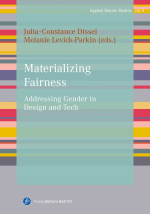
Addressing Gender in Design and Tech
edited by Julia-Constance Dissel and Melanie Levick-Parkin
Interested in more reading samples? Have a look at our blog.