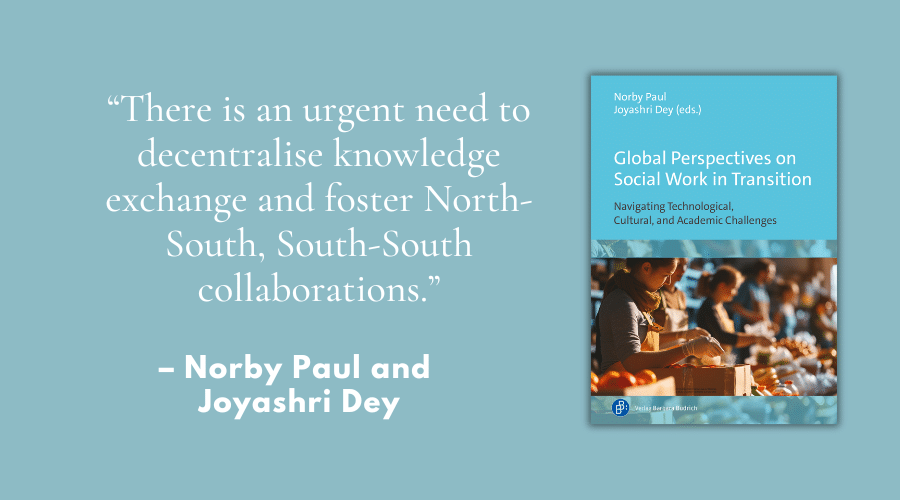
What are current challenges in social work post-covid, and how are they tackled in different regions of the world? We have conducted an interview with Norby Paul and Joyashri Dey, editors of “Global Perspectives on Social Work in Transition. Navigating Technological, Cultural, and Academic Challenges”.
Interview with Norby Paul and Joyashri Dey on “Global Perspectives on Social Work in Transition”
Dear editors, in this volume, you bring together 8 international perspectives on social work and its current challenges. Can you give some examples of what the contributions are about?
This volume presents a wide range of insights addressing current shifts in social work practice and education worldwide. Some of the chapters explore how digital technologies are transforming social service delivery, while others focus on cultural and regional challenges such as indigenous community resilience, migration and displacement, and the changing roles of social work educators in post-pandemic settings. Case studies from countries like India, Sri Lanka, Kyrgyzstan, Ukraine, USA and Germany illustrate how social workers navigate crises like gender-based violence, child protection, refugee resettlement, and community development with context-specific strategies.
How did the idea for this publication come about?
The idea emerged during a series of dialogues and collaborations among international scholars and practitioners, many of whom were reflecting on the post-COVID landscape in social work. We realised there was a pressing need to consolidate global experiences and perspectives to understand the profession’s evolution amid technological shifts, academic restructuring, and socio-political turbulence. The goal was to create a volume that brings together grounded experiences from diverse regions to encourage critical reflection and innovation so that the budding social work professionals be guided for future action.
What do you currently see as the greatest challenges for social work in the various regions of the world?
One major challenge is bridging the digital divide, while some countries are integrating AI and digital tools into social services, others still struggle with basic infrastructure. Another challenge is the shrinking space for social justice work in politically restrictive or conflict-ridden regions. Globally, the profession also faces rising mental health crises, Knowledge generation and uniform curriculum and practices, culturally sensitive social work, Indigenes social work climate-induced displacement, and a growing demand for culturally competent, inclusive practice. Simultaneously, social work education needs to respond with updated curricula, transdisciplinary approaches, and community-rooted pedagogy.
Is there enough international exchange in social work? Do you see a need for improvement?
While platforms like IFSW and IASSW have enabled meaningful global exchanges, the participation is often skewed toward institutions with more resources. Many valuable grassroots and regional practices go undocumented or unshared. There is an urgent need to decentralise knowledge exchange and foster North-South, South-South collaborations, amplify indigenous and community voices, and ensure that international social work doesn’t become overly Eurocentric, Africa-Centric or Asia-Centric, but a universal Approach tailored to consider culturally sensitive issues and concerns. We need more inclusive platforms, affordable publishing opportunities, and academic solidarity across borders.
What questions do you want to address next in your research?
Social Work and Climate-induced disasters, vulnerable and subaltern social work, Policy framework and social work that promotes uniformity, Displacement and social work and Migration, refugees and social work.
About the editors
 Norby Paul is an academician and practitioner with expertise in international social work, community development, and Migration and displacement studies for the last two decades. He has been associated with national and international NGOs and currently teaches in the Department of Social Work at a reputed Indian university. His research focuses on cultural transitions in global social work and participatory methodologies.
 Joyashri Dey is a senior academic with over a decade of experience in social work education and research. Her work centers around gender studies, social policy, and the integration of indigenous knowledge systems in welfare services. She is actively involved in curriculum development and international academic collaborations.
Order “Global Perspectives on Social Work in Transition” in our shop or download as e-book
Global Perspectives on Social Work in Transition
Navigating Technological, Cultural, and Academic Challenges
edited by Norby Paul and Joyashri Dey