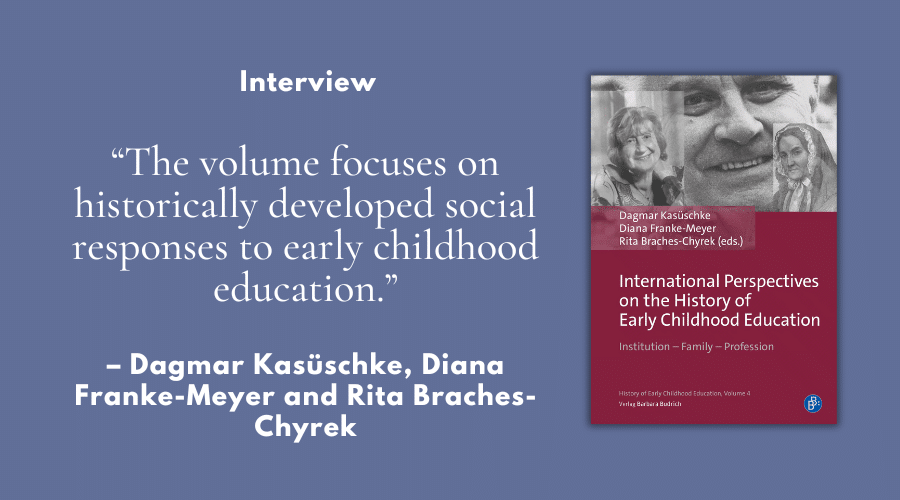
How does the interplay between family, institution and profession characterise early childhood education worldwide? In the volume “International Perspectives on the History of Early Childhood Education. Institution – Family – Profession”, the authors analyse the historical and theoretical developments in early childhood education from an international perspective. We have conducted an interview with the editors of the volume, Dagmar Kasüschke, Diana Franke-Meyer and Rita Braches-Chyrek.
The volume was published simultaneously in German under the title “Internationale Zugänge zur Geschichte der Pädagogik der frühen Kindheit. Institution – Familie – Profession” (ISBN: 978-3-8474-3154-1).
Dear editors, what perspectives exactly are you sharing in the volume “International Perspectives on the History of Early Childhood Education”?
This volume aims to examine the relationship between family, institutions and professions in the field of early childhood education from an international perspective, both historically and theoretically. The focus is not on international developments, but rather on the breadth of national perspectives on this topic. The following contributions, through their focus and perspectives alone, show which historically developed national perspectives on early childhood education are at the forefront and need to be critically reflected upon in terms of the challenges and potential of globalisation and local educational practices.
How did the idea for this publication come about?
The authors have diverse international academic contacts and have already published internationally elsewhere. The idea arose against the backdrop of an increasing trend towards the globalisation of education systems and growing criticism from academia, society and daycare practitioners, who emphasise the importance of socio-culturally developed educational cultures for the diversity of families. The volume focuses on historically developed social responses to early childhood education and the importance of the family.
Where are the biggest international differences in early childhood education – currently and/or historically?
In fact, a distinction can be made here between more socio-pedagogical and pre-school traditions. On the one hand, this has to do with the roots of early childhood institutions in different countries and their prevailing educational approaches but on the other hand, it also has to do with how early and how strong state regulation of the system was. While in many countries the focus is on the child’s readiness for school and an economic perspective, German-speaking and Scandinavian countries in particular focus on the individuality of the child, holistic education and the child’s self-learning abilities. Here, the educational partnership between parents and institutions is also more strongly characterised by participation, while in countries with a pre-school paradigm, parents are seen more as supporting the educational mission of the institutions.
The volume is published in both German and English. How well connected is early childhood research internationally?
The academic discipline of early childhood education is highly networked internationally and enjoys a good exchange of ideas, especially in empirical educational research. However, reading English-language literature that is aimed not only at academics but also at students and practitioners is not a matter of course. This is not the case in any of the countries that have contributed to this publication. To ensure accessibility for all interested professionals, we have opted for a German-language version. However, we also believe that this volume will be well received in an international context, particularly in English-speaking countries, as there is little comparable literature available there either.
Who would you recommend this publication to?
Scientists, university teachers and students in the field of early childhood education worldwide (English version).
Students at universities and practitioners of early childhood education (German-speaking).
About the editors
 Dagmar Kasüschke: studied educational science with a focus on early childhood education, research assistant and doctorate at the University of Dortmund, continuing education trainer for daycare centres, professor of early childhood education since 2006, currently at the University of Education in Schwäbisch Gmünd
 Diana Franke-Meyer: Kindergarten teacher, studied educational science, social pedagogue in various fields, teacher at a technical college for social pedagogy, doctorate from the University of Erfurt, since 2012 professor of educational science with a focus on elementary education at the Protestant University of Applied Sciences Bochum
 Rita Braches-Chyrek: Studied social sciences with a focus on social pedagogy, social pedagogy in various fields of activity, teacher at a vocational college, municipal equal opportunities officer, research assistant, doctorate and habilitation at the University of Wuppertal, since 2013 university professor, Chair of Social Pedagogy at Otto Friedrich University Bamberg, main areas of research and work: Theories, methods and history of social pedagogy, childhood, gender and generational research
Order “International Perspectives on the History of Early Childhood Education” in our shop or download as e-book
International Perspectives on the History of Early Childhood Education
Institution – Family – Profession
edited by Dagmar Kasüschke, Diana Franke-Meyer and Rita Braches-Chyrek
Interested in more interviews? Have a look at our blog.