How did migration politics develop in Germany, France and Canada? What are the differences and how did the countries’ approaches change over time? With “The Politics of Us and Them – The Migration Politics Nexus” Friederike Alm presents a comparative-historical analysis which sheds light on the historical trajectory of migration politics in Canada, France and Germany since 1945. The author proposes a new concept for migration research, the migration politics nexus, which highlights the interconnection between immigration, citizenship, and integration politics. We have conducted an interview with Friederike about “The Politics of Us and Them”.
Dear Friederike Alm, what questions are you addressing in your publication “The Politics of Us and Them – The Migration Politics Nexus”?
When the research project was developed, my main interest lay in our collective perception of important immigration countries. In light of the fact that Germany is among the most important immigration countries in the world today, but had historically resisted even wearing the label of immigration country, I wanted to understand how and why this development came about. It made sense to me to pick two other countries to compare with Germany, which had a divergent historical trajectory as immigration countries, but were also diverse democracies tackling similar questions surrounding difference and community, so the very politics of “Us” and “Them”. This is why I set out to understand 1) how these countries became immigration countries, 2) how integration and citizenship politics played a role in their respective trajectories, shifting a way from a more isolated analysis of only immigration countries towards a more comprehensive perspective which grasps these politics as part of the same process or nexus. Hence, my third and central question: What shape does the immigration, integration, and citizenship politics nexus in each country take throughout time?
Why are you comparing the migration politics of these three countries – Germany, France and Canada?
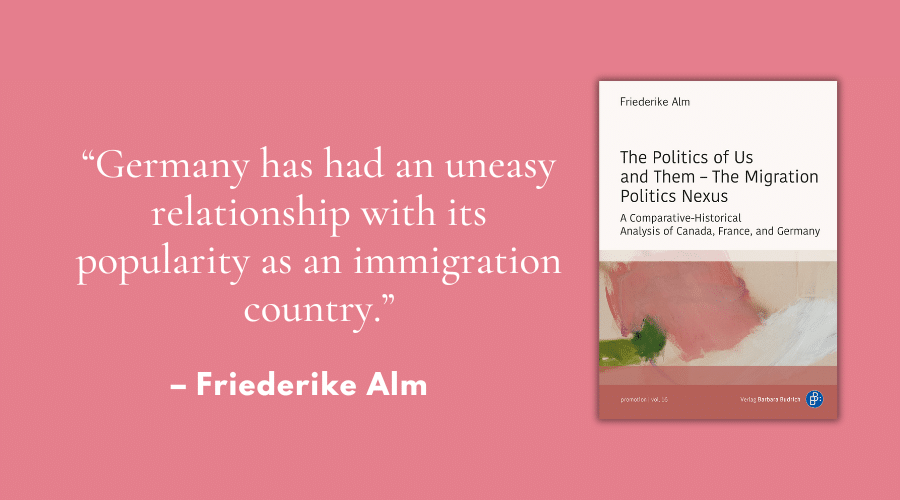
Germany has had an uneasy relationship with its popularity as an immigration country, as it kept resisting its development towards a very diverse society and, some might even say, still does so today. But as more than 30 percent of the population have a history of migration, it is important to understand how Germany compares and measures up to other immigration countries, particularly those who are far more confident and historically grounded in their self-conception as multicultural or diverse societies. This is how the selection of Canada came about. France, on the other hand, is Europe’s oldest and therefore most established immigration country, with active recruitment and casual political acceptance of immigrants dating back to the 19th century. It is, however, widely seen as a very different country to Canada, with an approach to its population diversity often described as assimilationist. Taking these three different, albeit politically and economically similar countries into a comparative-historical project therefore made complete sense.
What are the main similarities and differences that can be identified?
The main similarity in all three countries is that they all have a strongly established nexus of all three political fields, immigration, integration, and citizenship, by the end of the analysis. It appears unlikely that any of the three will halt immigration altogether, rather, it appears that immigration for economic expediency has become the dominant model, with on-going efforts to curb immigration for humanitarian reasons. Labour market needs, rather than right-wing anti-immigrant discourse, determine the prevalence of active immigrant recruitment policies in all three countries. This finding is in line with the existent research and provides grounds for the assumption that there will continue to be an ever-growing alignment in large democratic countries’ immigration politics. Unfortunately, it appears that the rise of the politicization of immigration has also taken hold in all three countries, which may hamper with the success of the recruitment policies, as hostility towards immigrants increases.
On the level of differences, the findings are far more complex. Depending on the historical period under analysis, the cases vary in their openness towards immigration, the grounds of their selection of immigrants and their perspectives on the permanency of immigration. At the end of the analysis, the starkest difference is discursive regarding the belonging of immigrants as a permanent part of the population.
How have migration politics changed over time in your research cases?
They have changed significantly. Prior to World War II, immigration was either not controlled at all (France) or there was a selection of immigrants based on ethnic origin (Canada). Immediately after World War II, both France and Canada tried to select immigrants based on their ethnic origin (with a preference for white and Christian Europeans), but would soon abandon this approach. Germany, conversely, had two groups of immigrants after WWII: Those who were war resettlers, with a claim to belong to the German community entrenched in Basic law, and those who were merely recruited for labour market purposes from the European South as well as Turkey.
From the 1950s and 60s onwards, the immigrant populations started to notably diversify and settle down in all three countries and a political reckoning process began on the way in which cultural diversity should be accommodated (or not) in the long-term. Canada settled this question relatively early with the state doctrine of multiculturalism, France and Germany struggled with a notable politicization of migration politics, in part reflected in the rise of single-issue right-wing parties, like the National Front in France. In the German case, conservative politicians like Helmut Kohl held strong in the denial of the de-facto immigration country Germany was becoming.
The 2000s brought a complete overhaul of German migration politics, with the politics of pragmatism taking hold, as it was opening up the reality of being a de-facto immigration country. It is in this period that Germany fully developed the markers of a liberal democratic immigration countries, with a comprehensive system allowing for citizenship acquisition for immigrants as well as a political discourse accepting the diversity of German society. The 2000s and 2010s were also very interesting periods for Canadian and French migration politics, but I will stop here and hope to have sparked your interest enough to turn to the book for more insights.
What follow-up questions arise from your analysis? Is there anything you would like to research next connected to your findings?
A fundamental question I am still grappling with is related to theories of democracy in relation to migration politics. In my analysis, I find that democratic immigration countries are often halted in efforts to curb immigration by virtue of the values they have committed to, entrenched in the Human Rights Convention, the Geneva Convention, or their respective constitutions. Both family and humanitarian immigration cannot be halted in democratic countries without infringing upon these commitments and it would be insightful to investigate the policy chasm that therefore emerges between democratic and non-democratic immigration states.
Another question pertains to the analysis of citizenship acquisition modalities and their impact on the long-term settlement of immigrants, as the attainment of citizenship as official membership remains a pivotal transition point from immigrant to non-immigrant.
About Friederike Alm
Friederike Alm studied Political Science, French, and Gender Studies in Frankfurt am Main, Lyon and Toronto. She completed her PhD thesis in Political Science in 2023 and afterwards took up a position as researcher for the European Migration Network (EMN), based at the German Federal Office for Migration and Refugees (BAMF). Her work focuses on the comparison of migration politics across European countries, contributing insights from the study of the German case to deliver policy analysis and advice to European and national stakeholders.
Friederike Alm’s dissertation was awarded the Budrich Dissertation Prize promotion.
An interview with the author in German about promotion is available on our German-language blog.
Order “The Politics of Us and Them – The Migration Politics Nexus” in our shop or download as e-book (open access

The Politics of Us and Them – The Migration Politics Nexus
A Comparative-Historical Analysis of Canada, France, and Germany
by Friederike Alm