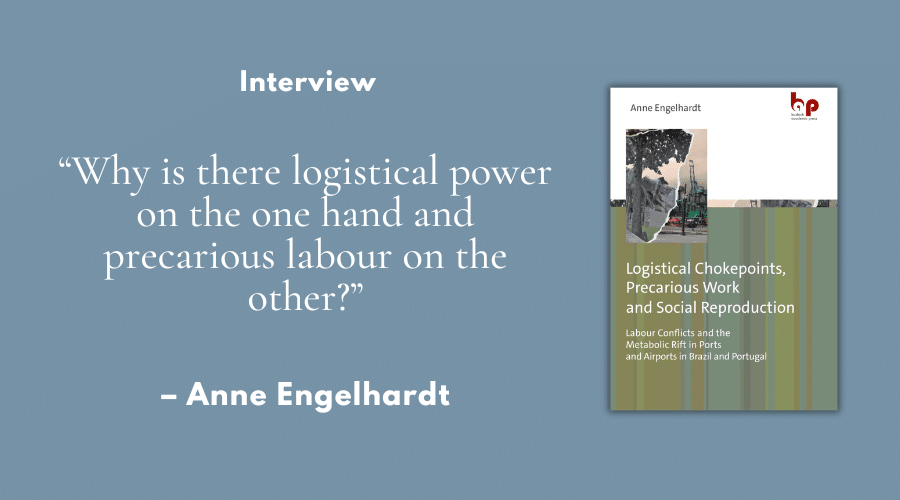
Sitting at pivotal points of globalized economies, workers in logistical chokepoints such as ports and airports should have a lot of negotiating power. Anyhow, their working conditions in ports and airports are still predominantly precarious. What is behind this? We have conducted an interview with the author of “Logistical Chokepoints, Precarious Work, and Social Reproduction. Labour Conflicts and the Metabolic Rift in Ports and Airports in Brazil and Portugal”, Anne Engelhardt.
Dear Anne Engelhardt, what questions are you addressing in your publication Logistical Chokepoints, Precarious Work, and Social Reproduction. Labour Conflicts and the Metabolic Rift in Ports and Airports in Brazil and Portugal?
My book essentially discusses three questions. Logistical chokepoints conceal a riddle. On the one hand, chokepoints such as ports and airports are widely celebrated as ‘magic bullets’ for struggles from below. Those working in such places, where goods and people enter and exit the economy, should have considerable ‘logistical’ power and consequently enjoy good working conditions. However, historically, working conditions at logistical chokepoints have been precarious and have fluctuated depending on racialised and gendered spaces.
So, I start with the question: Why is this? Why is there logistical power on the one hand and precarious labour on the other?
Secondly, I largely follow the insights that workers at chokepoints gave me during interviews about their working conditions, and their knowledge of changing laws and regulations. They addressed accidents, illnesses, depression, and other issues that impacted their mental and physical health. I wanted to know how the restructuring of work at chokepoints through monitoring, regulation, legislation and directives affects workers’ bodies.
My third question is how such effects are addressed and become a topic in labour and social movements around and at chokepoints. Therefore, I ask: how do trade unions and social movements address authoritarian practices and restrictions on the social reproduction of workers, and how do they develop strategies to obtain decent jobs at chokepoints?
How did you develop the questions of your study?
Initially, I was fascinated by the successful strikes at Lisbon’s ports between 2014 and 2016. Then there were the Ryanair strikes and protests at airports against deportations, and so on. I initially thought that chokepoints must essentially contain something like ‘logistical power’, given how often they are used for protests and strikes. However, having studied Deborah Cowen’s work on ‘The Deadly Lives of Logistics’ and the hyper-surveillance she describes, I thought this might prevent workers from exercising their logistical power. In English, there are two terms for ‘safety’ and ‘security’. In Portuguese, both are translated as ‘segurança’. Interestingly, when I wanted to address camera control, surveillance, and other possible aspects of security, the workers started to speak about safety. For example, they mentioned accidents, muscular problems, depression, fear, chronic fatigue, and a lack of time and space. I realised that these were topics that had hardly been addressed in industrial relations studies on logistics so far. This is how my fascination shifted from logistics to workers’ bodies and the struggle for occupational health and safety.
You describe that working conditions at logistical chokepoints such as ports and airports remain extremely precarious. What consequences has this for the workers, but also for societies and their states?
These interviews and discussions with workers changed my understanding of what ‘precarious work’ means because it is not necessarily characterised by low wages or short-term contracts. Some port workers in Brazil even prefer daily contracts, as they give them more freedom to choose their shifts. However, the precarity that they, and also workers at other chokepoints, experienced was more closely linked to physical insecurity and the uncertainty of potential dangers, such as containers breaking loose. Will a storm arise and shake the vessels? Are there enough safety measures? Is there enough equipment and stuff? Will there be unpaid overtime again? Are there enough changing rooms that are safe for all genders? And so on. I also came into contact with family members and friends who told me about their fears of losing their father, brother or sister to their work at chokepoints, or of being forced to care for them if they have a serious accident.
The consequences for workers vary depending on whether they work in a port or an airport. I spoke to port workers who had left their jobs. One of them told me that, during his 20 years working at a port, he had lost ten colleagues in fatal accidents. Another told me that he nearly died himself when a container broke loose. Many port workers are simply exhausted, depressed and overworked because their shifts are too long. Airport workers have a different experience. Due to improvements in disability rights since 2008, all airports must provide social assistance for people with walking impairments, etc. This has led to the development of a new sector of workers who provide social assistance and handle luggage, most of whom are women from ethnic minorities. They feel invisible. They are unseen by the state for health and safety protection, unseen by trade unions for bargaining and unseen by passengers. One worker told me that they are in ‘nobody’s world’. They feel as if they have no power at all. Interestingly, however, this has changed in the last couple of years, as there are more strikes in airports also from assistant workers.
For the state, the economy and society, having workers in such essential industries exposed to so many health and safety concerns is expensive. If workers are tired, they make more mistakes and more containers and commodities might get lost at sea, which pollutes the environment. It is also dangerous for the aviation sector. For example, a worker was once forced by management to drive a mobile assembly line despite not having a licence for it. The worker hit an aeroplane with the vehicle and reported it immediately, as this could render the aeroplane unfit to fly. Nevertheless, the worker was later prosecuted for the accident, even though they did not want to drive without a licence, but were forced to do so by management. The trade union fought for the worker’s reinstatement and emphasised that if more workers were prosecuted for similar reasons, they would stop reporting such accidents. This could lead to damaged aeroplanes attempting to fly, causing further accidents involving passengers and workers. This could affect aviation and trust in the safety of flights as a whole.
To what extent do the conditions vary between the different regions you examined?
In terms of the port sector, I found that working conditions were worse in Portugal than in Brazil, at least in the ports I visited. In Lisbon, the accident rate among workers was eith more than 80 per cent of workers experiencing them, more than double that in Santos, Brazil, and the same was true for chronic fatigue, affecting around 40 per cent of workers in Portugal compared to 20 per cent in Brazil. I discovered that this was partly due to the issue of temporal autonomy. Port workers in Portugal worked eight-hour shifts, often doing two per day. They reported doing a lot of overtime, whereas port workers in Brazil had much more flexibility in choosing their six-hour shifts. However, Brazilian workers have to overcome large spatial distances between their homes and workplaces, or between productive and reproductive spaces. The journey sometimes takes up to four hours each way, and they have to contend with poor road infrastructure and unreliable public transport. Working conditions were rather more similar in the aviation sector in both countries. Nevertheless, the history of the Brazilian aviation workers’ union movement is much longer and more impactful than that of the Portuguese aviation workers’ movement. The latter has hardly been researched until now. I hope to fill in some of the gaps in our current knowledge.
What follow-up questions arise from your study? What would you like to research next connected to your findings?
I would like to continue with about five different aspects. One is the question of climate change and socio-ecological transformation in logistics. Rising temperatures and heat, as well as an increase in storms and other weather extremes, affect the work. At the same time, the transport sector — especially aviation, but also shipping and ports — contributes significantly to climate change. Workers are greatly affected by the same industries in which they work and while they work in it. The hull of a ship can heat up to 50 or 60 degrees, as can airport runways in summer. Yet there are insufficient clothes or labour regulations to address this issue.
Secondly, airport work is a topic that has received little research attention, despite a number of labour conflicts occurring after the pandemic brought the sector to a standstill. I would, therefore, like to understand why, compared to the pre-pandemic period when airport strikes were rather, rare, there has been a sudden increase in such strikes since the pandemic, especially in Portugal, but also in Germany, the UK and other parts of the world. I assume this is related to the physical precarity of airport workers, who were exposed to a largely unknown and dangerous virus at that time, but I would like to dig deeper.
Thirdly, I would like to conduct further research in a neighbouring sector to ports: maritime transport and the working conditions of seafarers. During the pandemic, seafarers were held on board ships for much longer than before, causing a so-called crew change crisis affecting up to 800,000 seafarers, who either had to remain on board or were unable to start work and lost their income. Today, we are seeing an increase in the abandonment of ships and seafarers, as well as the impact of military conflicts on ships and seafaring, which I think is important to shed light on given that 90 per cent of our commodities are still transported by martime transport.
This leads me to the fifth aspect. The global regulation of transport and logistics labour must improve in terms of human and labour rights. Therefore, I want to increase my knowledge of due diligence laws and regulations, such as the recent German Supply Chain Act, which has had a positive impact on working conditions in several sectors, including the transport sector. However, such regulations are now under threat due to the current global shift to the right, with right-wing governments ignoring and also attacking basic human rights. I believe there is much more to write about to improve working and living conditions and create a more equal society.
About Anne Engelhardt
Anne Engelhardt is a lecturer and researcher in the BA of Social Sciences at the University of Göttingen. Here, she currently organised student-led research on labour struggles and emotional labour in the aviation sector.
Order “Logistical Chokepoints, Precarious Work and Social Reproduction” in our shop or download as e-book
Logistical Chokepoints, Precarious Work and Social Reproduction
Labour Conflicts and the Metabolic Rift in Ports and Airports in Brazil and Portugal
by Anne Engelhardt
Interested in more interviews? Have a look at our blog.