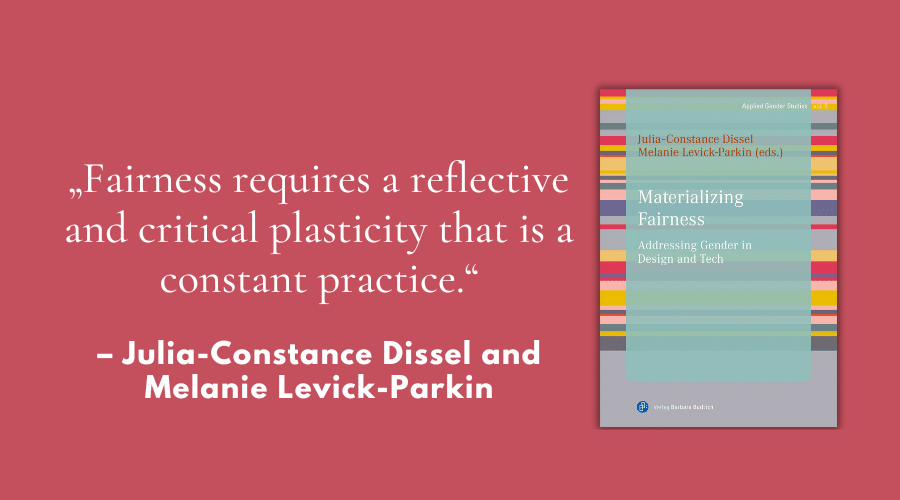
Women continue to be underrepresented in tech and design, resulting in their needs and perspectives being frequently overlooked. How can the gender gap in design and tech be tackled? We have conducted an interview with the editors Julia-Constance Dissel and Melanie Levick-Parkin of the volume “Materializing Fairness. Addressing Gender in Design and Tech”.
Interview with Julia-Constance Dissel and Melanie Levick-Parkin on “Materializing Fairness. Addressing Gender in Design and Tech”
Dear Julia-Constance Dissel and Melanie Levick-Parkin, what questions are you tackling in your publication, Materializing Fairness: Addressing Gender in Design and Tech?
The central theme of the book is how to articulate what fairness means in relation to equality, in particular how it might be practically realized in our highly designed and engineered world. Observing the world through an intersectional gender lens it becomes apparent that great imbalances still exist, and injustice affects not only members of society but also the natural world. We are trying to better understand how these things are linked and what the practical implications are if one might want to address some of these injustices. If we believe that finding ways to transform towards fairer and more balanced ways of being is the way forward, we would all benefit from sharpening these lenses. The aim of this edited volume is to bring together examples that don’t just illuminate the problem but that also grapple with finding ways and developing tools to make things for fair and equitable through practical solutions.
In your publication, you showcase successful initiatives and projects as well as personal insights across various sectors. How did the idea for this publication come about?
As a design philosopher and design educators, we are acutely aware that everything within the human mantle is designed, – from the chairs we sit on, to the cities we live in, to the systems that govern us. Nature has largely been co-opted into human culture as a neutral resource pit to be exploited as we see fit and just like the rest of the world, design is becoming more and more driven by digital technology. It is only natural that without conscious intervention, the drivers of that digital technology – like AI or coding for example – as well as the discipline of design as whole, reproduces existing societal patterns, including gender inequality. We don’t see this as the moral failure of primarily the individual who is designing any particular aspect within these systems but as a logic consequence of our world being dominated by a patriarchal capitalist system that is built on narrow normative stereotypes and biases, not just in relation to gender. Although gender inequality and unfairness are often framed as a female problem, as feminists we reiterate the position that the inequality and unfairness that come with patriarchal capitalism are ultimately bad for everyone and everything, irrespective of their gender identity and definitely including men. Within our work and with this publication, we aim to put a little pebble in the stream to add to work which aims to start to re-direct to flow of things towards what we conceive as more liveable outcomes. We believe design has a central role and responsibility to play and live up to within this broader project. One that might start with visible issues such as the gender pay gap or the gender data gap, but one that goes beyond it because part of the reproduction of unfairness and inequality is built into the design script, – materially and immaterially, –externally and internally. And this design script lives in our heads as much as in our actions and environments, so the first important act is one of reflection and becoming conscious because without that we cannot re-design the script passed down to us by our traditions and cultures. The contributions in this volume show some practical ways in which we as designers and actually everyone can materialise a different script.
What do you consider to be the biggest challenges in not only achieving equality but also genuine fairness in these fields?
The biggest challenge to achieving fairness is that there are no permanent quantifications or computations that we can fix into place and the adhere to. Fairness requires a reflective and critical plasticity that is a constant practice rather than a one-off achievable goal that can be ticked. All things being equal does not equate to equality or fairness because it has to speak to individual needs and values. What’s equal doesn’t need to be fair, and the other way around. This means that the challenge is more of a moral problem, which of course are never easy. So, a big hurdle is to not only make people aware of the complexity of achieving fairness but to encourage them to find their own moral compass which will motivate them to travel in that direction in the first place. This might then carry them through these complex contexts which often require the taking of time and finding different approaches. At times this can feel like being a tadpole trying to nudge a tanker in a different direction, so we need all the practical support we can get, and we hope readers will find a little of that in the book.
Was there anything that surprised you the most about the different contributions and their results?
One surprise were the very varied and imaginative approaches that design practitioners, educators and theorists are taking when they apply the force of their training and skills, as well as their intellectual agency to address issues around fairness, inclusion and equality, in relation to gender and beyond. Design is a very broad church but one thing we all have in common is that we are good at turning ideas and abstracts into concrete reality through our material practices. So even if the outcome or intervention is the design of a system which might appear immaterial, – at the heart lies the designerly skill to materialise solutions that have tangible consequences. It has been an absolute privilege to bear witness to so many practitioners applying themselves in their own imaginative way to writing design scripts that can help us travel towards more fair and just futures for people and planet.
Who would you recommend this publication to?
Designers, Engineers, Philosophers, Academics, Students, everyone!
About the editors
 Julia-Constance Dissel is Professor for Practical Philosophy and Cultural Philosophy at University of Applied Sciences in Darmstadt, Germany as well as running her own consultancy business for art & design projects. She was awarded Doctor of Philosophy in 2012 from Goethe University Frankfurt/M. after studying Philosophy, Art History and Archaeology in Frankfurt/M. and at the Albert-Ludwigs-University Freiburg and the University of Basel, Switzerland; additionally, she holds a postgraduate degree in Cultural and Media Practice from the Institute for German Literature and Didactic in Frankfurt/M. She has taught and researched in these fields at various academic institutions, amongst them the Max Planck Institute for European Legal History in Frankfurt/M., the faculty of Philosophy at the University of Oxford (UK), the HTWG Konstanz and The University of applied Sciences Darmstadt. She also was Visiting Professor for Perception Theory at the University of Arts and Design in Offenbach.
 Dr Melanie Levick-Parkin is a feminist design educator and researcher, who is interested in how intersectional feminist approaches can create spaces where design can be ontologically remade and put into the service of futures that are materially more just for all planetary life. Her teaching and research explore how gendered power relations are materialised and incorporates visual communication, design & making practices in relation to intangible cultural heritage, heritage, and archaeology, informed by design-anthropological approaches. Having left the creative industry many years ago for a life in the academy, she has taught and led a wide range of design courses, including the PG Design Programme at Sheffield Hallam University, served as an External Examiner at many institutions – most recently for the Politecnico di Milano Doctoral school, supervises PHD research in relation to design for health; decolonising design; and ontological design, and has contributed to a wide range of research and creative outputs which have included Horizon 2020 projects as well as collaborative exhibitions and public art in Greece and the USA.
Order “Materializing Fairness” in our shop or download as e-book
Materializing Fairness
Addressing Gender in Design and Tech
edited by Julia-Constance Dissel and Melanie Levick-Parkin
About the book
Women continue to be underrepresented in tech and design, resulting in their needs and perspectives being frequently overlooked. Addressing this gender gap requires substantial efforts across both academia and industry. While discussions around gender theories and the challenges of tackling tech and design from stereotypical viewpoints have increased, the focus often remains on the negative aspects. What is missing is a comprehensive look at real progress and the mechanisms driving it. This book closes that gap by showcasing successful initiatives and projects across various sectors – ranging from academia to industry, and from product design to engineering. It also examines how educational, social, economic, and ecological factors interplay in striving not merely for equality but for genuine fairness.
You’d like to read more interviews about interesting research? Have a look at our blog.