The publication “Global Trends: Prospects for Development and Peace. Multilateral Cooperation for People and Planet” edited by Cornelia Ulbert and Marcus Kaplan shows that rules-based multilateral cooperation remains necessary and possible in order to tackle the many global challenges we face. Based on longer-term trends, the articles explain in which direction joint global problem-solving can develop in selected areas. We provide a reading sample from the second chapter by Cornelia Ulbert here.
Strengthening a human-centred transformation: Rules for the digital world
Cornelia Ulbert
-
Introduction
When the High-Level Panel on Digital Cooperation, which was appointed by the United Nations (UN) Secretary-General, issued its report “The Age of Digital Interdependence” in 2019, it already predicted that the “speed and scale of change is increasing” and that “the agility, responsiveness and scope of cooperation and governance mechanisms needs rapidly to improve” (High-Level Panel on Digital Cooperation 2019: 6). The actual speed, however, with which especially applications based on artificial intelligence (AI) have developed since, not only raises high expectations of furthering human progress, but it also arouses fear of misuse and deepening social divisions. Therefore, the former “laissez-faire” global governance regime that was applied to providers of digital technologies (Jia/Chen 2022: 291) has come under pressure, since the social impacts of digital platforms and digital technologies, like a growing amount of disinformation and polarization within and between societies or a systematic violation of data privacy, are felt more profoundly than before.
Both the benefits and risks transcend national borders. We can see various models of regulating the development and application of digital technologies globally. However, the ways and principles of how to do this differ, especially between the three main economic contenders, the United States, China, and the European Union (EU). There has been a stark increase in regulating digital technologies, especially AI systems, over the past years, mainly at the national or regional level. Consequently, the term “digital cooperation” was coined to capture “the ways of working together to address the societal, ethical, legal and economic impacts of digital technologies in order to maximize benefits to society and minimize harms” (High Level Panel on Digital Cooperation 2019: 6). In 2020, amidst the COVID-19-pandemic, the UN devised a “Roadmap for Digital Cooperation” (UN 2020), emphasizing that this will be instrumental in achieving the Sustainable Development Goals (SDGs) as a joint multi-stakeholder effort. The UN’s work to further digital cooperation culminated in the “Global Digital Compact” that was adopted by the UN General Assembly as part of the “Pact for the Future” in September 2024 (UN 2024). Geopolitical tensions, the growing spread of autocracies combined with the demise of the liberal international order, however, have led to more and more countries and regional players emphasizing their “digital sovereignty”, a concept related to regulating digital spaces and strengthening technological autonomy (Lambach/Monsees 2025: 72).
This chapter engages with this trend of a growing fragmentation of digital governance with competing institutional and policy approaches in the face of a general backlash of multilateral cooperation. Nevertheless, for managing the benefits and risks of digital technologies, especially those based on AI, the digiätal world needs rules that must be based on certain principles which are globally acknowledged like inclusivity, fairness, transparency or respect for human rights. In an age of digital interdependence, however, the exertion of “digital sovereignty” can only be extended beyond the range of economic and political powerful actors when the number of global digital public goods will increase.
-
Principles guiding the global digital transformation
The simple fact that digital technologies transcend national borders renders purely national approaches insufficient. Historically, global cooperation on information and communication technologies (ICTs) started with regulating global connectivity issues by providing the necessary infrastructure. This also led to shared standards and securing interoperability, which predominantly fell into the domain of the International Telecommunication Union (ITU) and later, with the advent of digital technologies, other technical bodies like the Internet Corporation for Assigned Names and Numbers (ICANN). Technical compatibility means that networks, devices, and services work across borders and that harmonized frameworks for cross-border data enable, for instance, global supply chains and other economic or social exchanges.
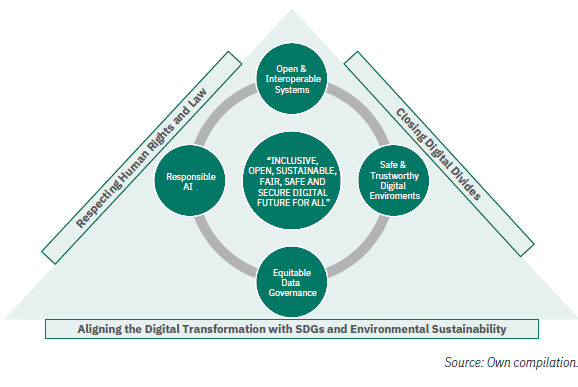
Multilateral cooperation is also needed for two additional reasons: On the one hand, to cope with the risks and harms associated with digital technologies, especially infringements of individual rights, like data privacy violations, or cybersecurity threats, e. g. cyberattacks, cybercrimes and disinformation campaigns. On the other hand, digitalization is also seen as a means to further the achievement of the UN Sustainable Development Goals (SDGs) (Francisco/Linnér 2023). The “SDG Digital Acceleration Agenda”, a joint initiative led by ITU and the UN Development Programme (UNDP) expects “game-changing digital solutions [… to] accelerate progress in climate action, education, hunger, poverty and at least 70 per cent of the 169 SDG targets” (ITU/UNDP 2023: 3). For the UN, digital cooperation has to focus on a “human-centred digital transformation” (UN 2023: 6), which is explicitly linked to the 17 SDGs. Moreover, with progress on implementing the SDGs stalling, aligning the digital transformation with the SDGs and environmental sustainability is one of the overarching guiding principles that is also shared, amongst others, by the G20 and the Organization for Economic Co-operation and Development (OECD) (G20 2023, OECD 2021) [see Figure 1].
FIGURE 1: Safeguarding a human-centred digital transformation
Principles guiding the global digital transformation on a normative and operational level
Since much of the work of UN and other multilateral bodies revolves around norm-setting, safeguarding civil and human rights in the digital age has become one of the most-cited principles in digital cooperation.[1]
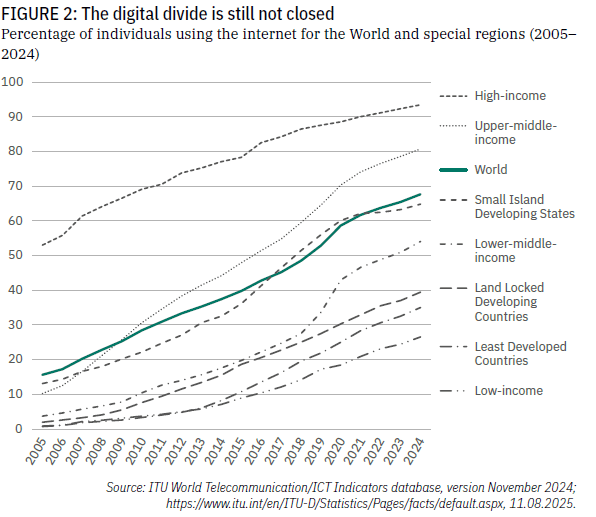
With the “Framework Convention on Artificial Intelligence”, the Council of Europe opened the first-ever international legally binding treaty for signature in September 2024, which “aims to ensure that activities within the lifecycle of artificial intelligence systems are fully consistent with human rights, democracy and the rule of law, while being conducive to technological progress and innovation”.[2] According to the UN Global Digital Compact the goal of the current digital transformation should be “an inclusive, open, sustainable, fair, safe and secure digital future for all” (UN 2024: Annex I, Para. 4). The realities of today’s global access to information and communication technologies (ICTs), however, still reflect the ongoing digital divide between high-income and low-income countries, when you look at key ICT indica tors like internet access [see Figure 2]. This is why ensuring universal and equitable digital access has been ranked highly amongst the list of normative principles. On an operational level, you can summarize various catalogues of principles into four principles that also reflect the historical development of digital technologies. These principles focus on 1) open and interoperable systems, 2) safe and trustworthy digital environments, 3) equitable data governance, and 4) responsible AI.
FIGURE 2: The digital divide is still not closed
Percentage of individuals using the internet for the World and special regions (2005–2024)
Open and interoperable systems like the internet are necessary to preserve net neutrality and global digital spaces. Governing the internet has never been a purely technical issue, as the history of the World Summit on the Information Society shows, which led to the creation of the multistakeholder Internet Governance Forum in 2006 as the principal discussion forum on issues of internet governance. To protect users against online harm, misinformation and security challenges it is necessary to create safe and trustworthy digital environments. Many consider data as the most valuable resource that can be mined in the digital age. Hence, the principle of equitable data governance is key to enable privacy-respecting, interoperable, and inclusive use of data. Finally, with the global roll-out of more and more AI-based applications, the question of “responsible AI” has become of utmost importance. This has led the UN Secretary-General’s multistakeholder High-Level Advisory Body on Artificial Intelligence to call for “Governing AI for humanity”, based on inclusive and risk-based approaches (High-Level Advisory Body on Artificial Intelligence 2024). Although the risks and problems of digital technologies were known before, they have been exacerbated with the rapid development of AI-based application and, subsequently, have resulted in numerous national and multilateral regulations worldwide based on different regulatory approaches (Congressional Research Service 2025).
[1] Besides the UN Global Digital Compact (https://www.un.org/global-digital-compact/en; 14.08.2025) see also the OECD principles for trustworthy AI (https://oecd.ai/en/ai-principles; 14.08.2025).
[2] https://www.coe.int/en/web/artificial-intelligence/the-framework-convention-on-artificial-intelligence; 14.08.2025.
***
Would you like to continue reading?
Order “Globale Trends” in our shop or download as e-book
Global Trends: Prospects for Development and Peace
Multilateral Cooperation for People and Planet
edited by Cornelia Ulbert and Marcus Kaplan
The publication “Global Trends: Prospects for Development and Peace. Multilateral Cooperation for People and Planet” edited by Cornelia Ulbert and Marcus Kaplan is part of the newly released book series “GLOBAL TRENDS: Prospects for Development and Peace” edited by the Development and Peace Foundation (sef:).
Thee volume is also available in German under the title “Globale Trends: Perspektiven für Entwicklung und Frieden. Multilaterale Kooperation für Mensch und Planet”.