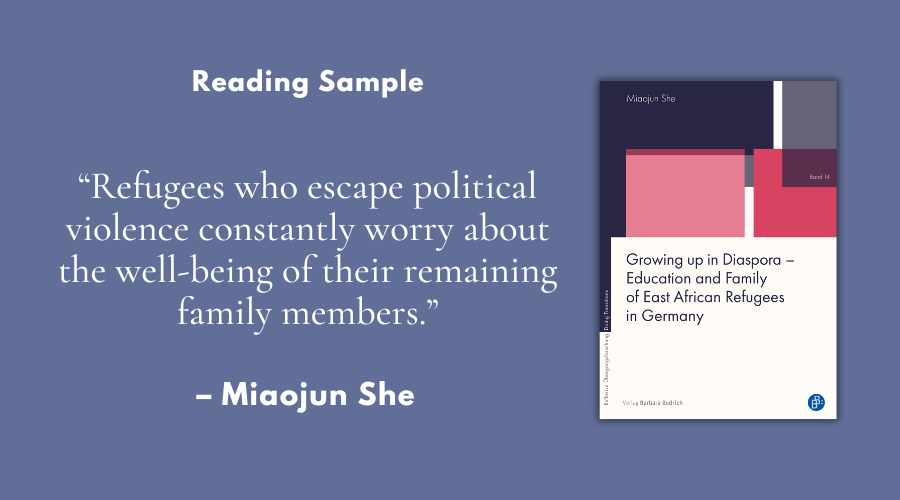
Miaojun She’s book “Growing Up in Diaspora – Education and Family of East African Refugees in Germany” centers on the life experiences of young East African refugees in Germany. Situated at the intersection of migration and transition research, it depicts an extensive picture of how young refugees cope with challenges related to educational and occupational participation. How do they maintain transnational familyhood amidst the institutionalized discrimination in the receiving society? The author portraits different ways of coping with transition imperatives, showing how young refugees shape their biographical trajectories with the sociocultural as well as biographical resources they have. Find a reading sample from chapter 6 from her book “Growing Up in Diaspora” here.
6.3 Family and the Dialectic of Transmission and Transformation
As the previous section demonstrates, family significantly shapes young refugees’ educational pathways at home, during migration, and in host societies. This section further elaborates how family influences refugees’ lives during their migration and transition trajectories and illustrates how young refugees orient themselves within a transnational family and migration network. This section concludes with a discussion of the dialectic relationship between transmission and transformation, namely the dynamic process by which transnational family connections contribute to the continuation of cultural norms and social orders, and, on the other hand, also initiates transformational practices that guide refugees down a path different from that of their parents.
6.3.1 Family and the Collective Migratory Path
Research underscores that migration is often not an individual but a collective endeavor, based primarily on family and kin relationships (Christ et al. 2021; Etzold et al. 2019; Patterson 2023; Serra Mingot 2023). For East African refugees, migration frequently represents the irst step in the family’s broader migratory path. The unpredictability and extreme hardship of the journey, combined with the high cost of human trafficking, make older family members more hesitant to emigrate. It is therefore more common for teenage boys or young adults to take the risk and attempt the journey through the Sahara and across the Mediterranean toward Germany. However, without their families’ informational and economic support, they would rarely be able to manage the journey or reach their destinations.
As the first part of this chapter introduced, Ole ran away from home and traveled to Sudan without informing his family. Once there, he contacted his parents and asked them to pay the trafficking fees so that he could continue his journey. Similarly, Jerry dropped out of school at 17 and went to Sudan, having learned about the route through information and experiences shared by his relatives and acquaintances. After arriving in Sudan, he called his parents, informed them of his situation, and asked them to pay the traffickers five thousand dollars to finance his journey. After several years in Germany, Jerry saved enough money to fund his younger brother’s journey to Europe. By that time, however, the price had risen from five thousand in 2014 to eleven thousand in 2021, which exhausted his savings and forced him to postpone his plan to obtain a driving license. In the winter of 2021, his brother successfully arrived in Europe with his support. Ole’s and Jerry’s migration processes illustrate a common pattern among East African refugees: the migration journey depends on the collective efforts of family members. They would not have been able to undertake the initial migration steps without their families’ informational, emotional, and economic support. After reaching their destination, they carry reciprocal responsibility toward their families, whether by providing financial support or facilitating the successive migration of other family members. In this sense, migration becomes a collective family experience.
Although family relations are the most binding ties and play the central role in shaping migration trajectories, broader social connections—such as those with distant relatives, neighbors, or parents’ friends—also contribute, particularly by providing information, advice, or accommodation during transit. For instance, when Armin ran away from home and went to Ethiopia, he stayed for several months with a relative of a friend. He then travelled to Sudan and stayed with another relative, who cared for him and helped him connect with others planning to travel to Europe through Libya. Armin believed that without their support, he would not have reached Libya and, ultimately, Germany. Likewise, after Fiona lost her parents, she fled to a neighbouring city and lived with her aunt for two years. It was her aunt who suggested that she leave the country. Although Fiona was initially reluctant, she eventually accepted the advice and sought refuge in Sudan, where she stayed with a friend of her aunt. These cases demonstrate how refugees often rely on broader social networks during their journeys. Their routes and tempos are frequently shaped by the resources they encounter along the way, and their eventual destinations often emerge from historical contingencies and the interplay between possibilities and material circumstances.
Extensive research has shown that refugees often experience non-linear migration routes characterized by transits, reorientations, and onward journeys to third countries (e.g., Ahrens and King 2023; Collyer and de Haas 2010; Düvell 2012; Salamonska 2017). Actual routes and mobility experiences depend on the structures and practical constellations in which refugees find themselves.
It is widely acknowledged that family and kin networks structure and contour these constellations. Etzold et al. (2019) use the concept of translocal figurations of displacement to describe how figurational networks of family and kin shape and reshape refugees’ experiences and desires for mobility. This concept highlights the processual character of refugee lives and how they center on networks of interdependent human beings, in which family and kin represent central forms of unity, belonging, and support, providing essential resources for both mobility and immobility (Tobin et al. 2023). These figurational networks—constituted by de-territorialized interdependent relations, communication, and transactions—can facilitate certain forms of mobility while hindering others. This underscores the decisive role of family and kin relations in refugees’ everyday lives and migratory paths. In this sense, even when migration is carried out by individuals, it often constitutes a family project, defining a collective migratory trajectory and shaping a shared transition.
As the previous section explained, the concept of linked lives emphasizes that refugees’ practices related to migration transitions are both influenced byand exert influence upon their family and transnational kin networks. Individualistic descriptions of refugees’ migratory paths overlook the extent to which these pathways are carved out and entangled with those of others. Refugees’ transitions often entail corresponding transitions for their families (Elder et al. 2003). Rather than conceptualizing migration as an individual life-course transition, it is more appropriate to understand it as the intersection of individual and family lives within their socio-historical contexts. Migration constitutes a transition not only for the migrants themselves but also for their families, involving farewells, the provision of information, material and emotional support, and the maintenance of transnational familyhood. Young refugees’ migration is therefore a transition they share with their families, as they undertake the journey together, sustain family life across borders, and simultaneously achieve new states of existence.
6.3.2 Transnational Familyhood
For young East African refugees, transnational familyhood is defined by emotional ties, financial support, maintenance of social networks, and de-territorial coexistence in settings such as ceremonies, religious rituals, and funerals. Research confirms the significance of migrants’ emotional connections with their homeland families, especially those from countries experiencing extensive political turmoil (Lim 2009; Luster et al. 2008; Luster et al. 2009; Savic et al. 2013). Refugees who escape political violence constantly worry about the well-being of their remaining family members and feel the need to maintain contact with them. A South Sudanese woman who resettled in the United States explained:
I think about [South Sudan] a lot and the people there…Those people there, they are an everyday presence in my life. I think about the challenges that my sisters face and the lack of opportunity that they have and how they struggle…I wake up every day with those things in my mind (Faria 2014:1059).
The enduring warfare and social unrest in East Africa compel refugees to frequently confirm the safety of their remaining family members. As a Nuer refugee commented:
It is very important [to keep connected] because they have so many problems there …food, security, sickness, and fighting going on all the time. You don’t know. Today you can talk with them and tomorrow there is fighting and your relative killed. You always worry, so you keep contact, ”Are you okay?” “Oh, okay, good!” (Lim 2009:1037).
Families who stay in the homeland also worry about how their children who have emigrated can make a living on their own. Research shows that parents are commonly concerned about whether their emigrated children have proper food and accommodations, whether they will find a job, and whether they will receive a residence permit (Lim 2009). Regular communication and sharing of daily experiences effectively relieve both sides’ anxiety and maintain emotional ties in the transnational family domain. Accordingly, research underscores the significance of family connections in refugees’ integration and wellbeing (Christ et al. 2021; Pieloch et al. 2016; Rossiter et al. 2015).
However, long-distance emotional connections can be ambiguous. While refugees maintain family intimacy through sharing their emotions, they also conceal aspects of their struggles. For example, Markus tries to ease his mother’s concern by constantly saying he is doing well. He did not disclose any details about his asylum application problems, instead comforting her by insisting that things were on track. The physical distance and separation of living worlds greatly limit how homeland families gain information about their children’s daily lives. They must rely on brief statements about the situation, giving refugees significant discretion over what to share and what to withhold.
Since physical distance restricts how refugees express care for their families, they commonly rely on material compensation to support them. Kai repeatedly left school to take seasonal jobs so he could send remittances back home and uphold his responsibility to his family. He sees himself as the first in the family to finish school, gain knowledge about modern technologies, and connect with broader society. He feels responsible for helping his younger brothers finish school and encouraging them to pursue further education. Similarly, Ole and Jerry’s parents’ financial support enabled them to reach Germany. They repaid their families by sending remittances once their financial situations stabilized.
This pattern illustrates familial reciprocity and shows how migration can be viewed as an investment. Initially, parents pour their resources into supporting their children’s migration journey, sometimes even taking on loans to cover the costs. After the children settle down and earn money, they pay off outstanding loans, improve the family’s economic conditions, and support the migration of other family members. Migration is therefore a family strategy to survive disaster and invest in improvement—especially in contexts of rapid social change and turbulence. Sending family members abroad is an important way for families to increase their chances of survival and improve the living conditions of those who remain behind (Castles 2012; Hugo 1994). Sending remittances is thus an essential component of family investment in migration and plays a significant role in how financial resources are managed in transnational familyhood. Moreover, scholars emphasize that sending remittances is a transnational practice. As part of migrants’ efforts to sustain ties with their countries of origin, remittances can be seen as a proxy for transnational commitments (Carling and Hoelscher 2013).
***
Would you like to continue reading?
Order “Growing Up in Diaspora” in our shop
Growing Up in Diaspora – Education and Family of East African Refugees in Germany
by Miaojun She
Interested in more readings samples and interviews? Have a look at our blog.