Sustainability Report 2024
Strategy
01 Strategic Analysis and Measures
Our sustainability strategies are embedded in our corporate strategy. Our mission states:
“At Verlag Barbara Budrich and Barbara Budrich Academic Press, since our foundation we have been committed to giving greater visibility to the social and educational sciences within the concert of the sciences. The social and educational sciences address the societal challenges of our time as objects of research. We are convinced that insights from the sciences can be made fruitful for society.”
In line with our mission, our publishing programme covers many thematic areas of the SDG 17. In particular, our publications address the following goals:
1 No Poverty, 3 Good Health and Well-being, 4 Quality Education, 5 Gender Equality, 8 Decent Work and Economic Growth, 10 Reduced Inequalities, 11 Sustainable Cities and Communities, 12 Responsible Consumption and Production, 13 Climate Action, 16 Peace, Justice and Strong Institutions.
Our publications primarily originate from the fields of educational science, gender studies, political science, social work and sociology and address these – and further – socially relevant topics from their respective disciplinary perspectives. Political education, for example, is a particular concern for us and contributes to Goal 16.
As a company, through our wide range of strategic partnerships we are aligned with Goal 17, “Partnerships for the Goals”.
Since 2020, we have been providing online information about our efforts in the field of sustainability with regard to ecological and social sustainability as well as ethical corporate governance. In doing so, we consider both environmentally sustainable practices on site within our own companies and the conduct of our suppliers and partners. We ensure that social aspects within the team are taken into account and, in line with our values, we strive for an appreciative and respectful working environment.
02 Materiality
Climate change, wars and numerous crises pose major challenges for society as a whole. The publishing industry, particularly in the field of academic publishing, is undergoing profound transformation. Driven by the political expansion of open access, digitalisation in general and developments in artificial intelligence, our environment is changing rapidly. Demographic change, the associated shortage of skilled labour and the changing expectations of younger generations are further factors shaping our view of the present and the future.
In addition to the programmatic and content-related development of the publishing houses – in particular in the field of political education – the focus of our corporate and, consequently, our sustainability strategy therefore lies on:
- increasing the share of open-access publications as an instrument for the broad dissemination of verified knowledge and for reducing the volume of print production,
• increasing efficiency through digitalisation and innovation – including the prudent and responsible use of AI –,
• measures for climate and environmental protection.
03 Goals
As climate change is one of the greatest challenges of our generation, we see the greatest leverage for ecological sustainability in the field of climate protection. To this end, we intend to prioritise open-access production over traditional print production. This has the positive side effect of making high-quality academic publications available to the general public: access to these files is free of charge. At the same time, we aim to make print production as resource-efficient as possible.
Our key targets by 2030 are:
- at least FSC-certified production (or a higher environmental standard) for 20% of our print production of new publications and journals. FSC-certified papers and cover materials are already used for most of our products. For some publications, we apply higher standards, such as papers certified with the “Blue Angel” eco-label or cradle-to-cradle production;
- increasing the share of open-access publications to 70% of new publications and journals;
- reducing CO₂ emissions (Scope 1 to 3) by at least 25% compared to 2023.
Progress towards and achievement of these targets is supported and monitored in various contexts by management, individual team members and stakeholders. The two sustainability officers review progress and target achievement for points 1 and 3, while programme management coordinates and monitors point 2 together with management.
04 Depth of the Value Chain
While the publishing house has direct influence over its own activities, we depend on suppliers and partners in many areas. In this context, different stages of the value chain can be identified.
Production of Books and Journals Within the Company
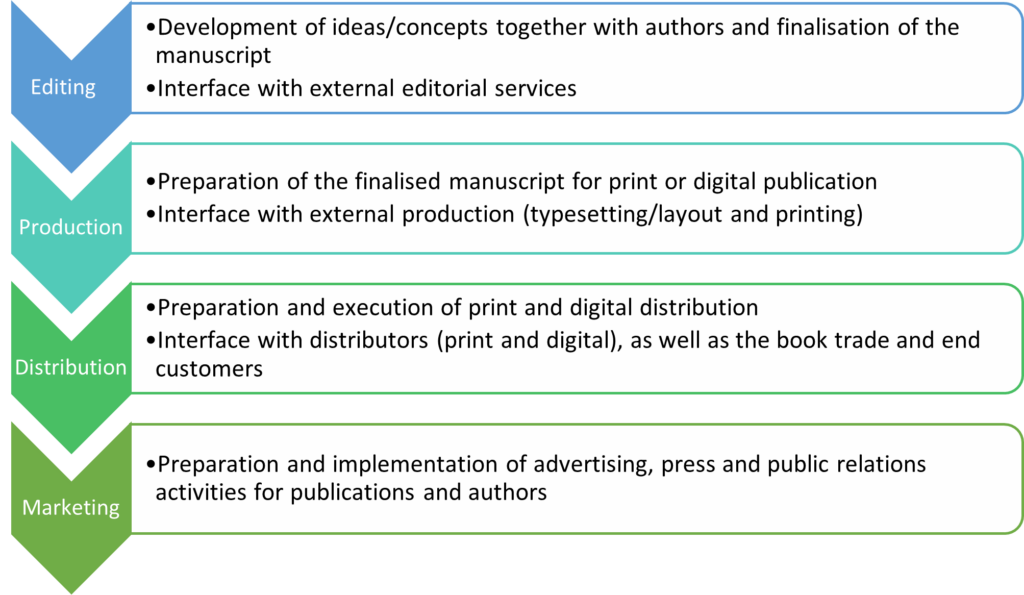
Interfaces in the Life Cycle of Our Products
External Editing, Typesetting and Design
We cooperate with a large number of freelancers, primarily in the areas of editing as well as typesetting and design.
Print Production
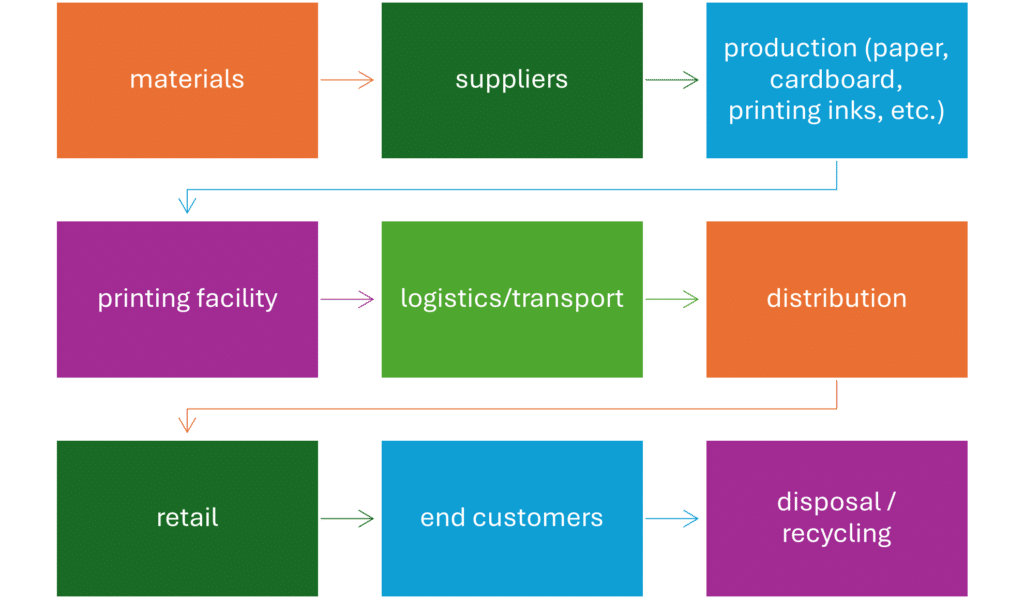
Digital Production and Distribution
In digital production, the focus lies on hosting and the use of digital products. This requires, on the one hand, appropriate hardware (servers, computers, end devices) and, on the other hand, energy to operate these devices.
Whereas resource consumption for a print publication is relevant only once – namely during actual production and shipping (which may of course take place more than once) – digital publications require energy whenever they are used. At present, we are unable to quantify the effort involved for intermediaries (e.g. libraries) and end users. In the longer term, we also rely on the decarbonisation of electricity grids.
Sustainability Aspects, Challenges and Approaches to Solutions
Impulse Catalogue with a View to Ecological Sustainability
For interfaces with other companies, we have developed an impulse catalogue that enables us to address basic aspects of ecological sustainability together with our partners.
Print Production
Our print production takes place primarily in Germany. A proportion of orders is placed in Poland, and a small number in Austria. The main challenges here lie in keeping track of ecological sustainability aspects related to materials and production. Our printing partners use at least FSC-certified materials, and in some cases materials certified with the “Blue Angel” eco-label. For special projects, we use FSC-certified production or – where economically feasible – cradle-to-cradle (C2C) production, i.e. genuine circular economy approaches. In this area, a tension arises between ecological and economic sustainability, as prices for our products cannot be increased to such an extent that our preferred C2C production would be feasible for all print products.
A further challenge results from the small print runs of our production and the associated print-on-demand processes, which can lead to increased transport volumes. Our current strategy, where demand for individual publications is low, is to opt for the production of very small print runs rather than single-copy production. As a result, shipment of copies to customers is usually handled by our partner Brockhaus, which offers the greatest potential for bundling orders.
When calculating CO₂ emissions for print production, we of course also take into account transport emissions from the respective production site to our customers (where possible) or to distribution, most commonly Brockhaus, or alternatively to one of our international partners.
International Partners
A small proportion of our English-language book production is printed in very small runs in the United States and distributed by our partner there, Columbia University Press. Columbia University Press is part of the Columbia University Group and participates in its sustainability and climate protection measures, such as the Sustainable Columbia campaign and its Plan 2030. Beyond this, Columbia University Press also sees it as its mission to contribute to the solution of global problems through its publications in the field of climate research.
To a very limited extent, we transport our print products to international partners as far as Asia (e.g. Inspirees in China). At present, we have no knowledge of the sustainability status of these partners.
Print Distribution in Germany
Our largest distribution partner is Brockhaus Commission in Kornwestheim. Brockhaus has committed itself to sustainability, with its Agenda 2030 aiming for climate-neutral operations by 2030. This is accompanied by resource conservation and future-oriented, climate-friendly and fair corporate governance.
Numerous other retail partners likewise place a strong emphasis on sustainability in the areas of ESG.
Hosting
Our hosting partners (All Inkl and Mittwald) place great importance on ecological sustainability.
Process Management
05 Responsibility
Responsibility for the sustainability strategy as part of the corporate strategy lies with management. Two sustainability officers have been supporting monitoring activities and the implementation of operational measures since 2020. In addition, they maintain contact with external initiatives, such as the Sustainability Interest Group (IG Nachhaltigkeit) within the German Publishers and Booksellers Association.
06 Rules and Processes
Our sustainability strategies are embedded in our standard processes. Through exchanges with external interest groups, our suppliers, partners and other stakeholders, we keep our knowledge up to date, review our processes for potential improvements and work continuously to improve. This sustainability report is updated annually, which automatically results in our targets, measures and processes being reviewed.
07 Monitoring
The data we collect to review our prioritised targets will continue to be gathered using consistent methods. Indicators include regular analyses of our production (targets: 1. FSC standard of print production, 2. increase in the share of open access) as well as the recording of CO₂ emissions (3. reduction of CO₂ emissions). We expect data relating to greenhouse gas emissions to become more precise over time, as suppliers and partners will in turn provide us with more detailed information.
The individual methods are presented in section 13.
08 Incentive Systems
Working in a sustainably oriented company and jointly committing to a better world is an intrinsic motivation for the entire team. Identification with the company and a sense of personal effectiveness, for example with regard to sustainable action and innovation, constitute a major non-monetary incentive that motivates both management and the team alike.
The two sustainability officers monitor progress, while the entire team and further stakeholders – suppliers, partners and our authors – provide impulses to discuss and implement potential improvements.
09 Stakeholder Engagement
The different stakeholder groups were identified in strategy workshops. Classification with regard to interest in and influence on the sustainable actions of the publishing houses was carried out by management.
We distinguish in particular between the following groups:
| Group | Interest in Sustainability | Influence on Sustainability |
| Employees | High | High |
| Suppliers | Medium | High |
| Partners
(e.g. freelancers) |
Medium | High |
| Industry customers | Medium | Medium |
| Academic institutions | Medium | High |
| Authors | High | Medium |
| Readers | Medium | Medium |
The exchange with the different stakeholder groups takes place partly on a day-to-day basis (team), partly in a structured manner, for example through regular meetings of focus groups (e.g. the academic advisory board as representatives of authors/readers), and partly on the occasion of specific events (exchange with partners, suppliers and the industry). The outcomes of these exchanges are documented by team members and forwarded to the responsible units within the publishing houses.
Further systematisation of stakeholder engagement is being discussed between management and the sustainability officers.
10 Product and Innovation Management
At present, print production is the business area with the greatest potential for improvement, both with regard to resource conservation, the reduction of environmental pollution (inks, adhesives, paper production) and deforestation (paper), as well as greenhouse gas emissions across the entire value chain. By focusing on open access and further digital innovations, we aim to minimise our print production.
Together with our partners, academic institutions and authors, we are developing innovative publications for the academic community and making them available to downstream practice.
Initial small steps, such as dispensing with protective plastic wrapping around our printed publications, have already been implemented since 2020.
Ecological Sustainability
11 Use of Natural Resources
Within our value chain, natural resources are primarily used in print production.
In addition, resource consumption occurs in the context of everyday office operations – ranging from office furnishings and equipment, cleaning activities, to the consumption of resources for heating and electricity.
12 Resource Management
In the area of print production, we pursue two objectives:
- reduction of print production through effective print-run planning on the one hand and by further advancing open-access production on the other;
- print production that is as environmentally and resource-efficient as possible through high environmental standards – the use of FSC-certified or Blue Angel–certified materials and FSC-certified production up to cradle-to-cradle (C2C) production, where economically feasible.
In addition, we pay attention to the use of ecologically harmless products, for example in cleaning, procure office and consumable materials that meet high environmental standards (FSC, recycled materials, Blue Angel), and equip our offices, where possible and economically feasible, with used or ecologically high-quality furnishings.
13 Climate-Relevant Emissions
| Emission source | Emissions 2023 | Number of publications 2023 | Emissions 2024 | Number of publications 2024 | Change (%) | Overall change |
| Production | 19,743 kg | 268 | 13,594 kg | 287 | −31.15% | −6,149 kg |
| Emissions per project | 73.67 kg | 47.4 kg | ||||
| Goods transport | 3,924 kg | 268 | 3,924 kg | 287 | ±0 | ±0% |
| Emissions per project | 14.64 kg | 13.67 kg | ||||
| Total production | 23,667 kg | 17,518 kg | −35% | −6,149 kg |
Compared to the previous year (2023), CO₂ emissions in the area of production were reduced by 31.15% in 2024, despite the fact that overall production volumes were higher in 2024.
In the area of goods transport, the following picture emerges: assuming a constant number of transport journeys from the printing facilities to the warehouse, this results in a correspondingly lower level of CO₂ emissions per project.
The production sector therefore shows an overall reduction in CO₂ emissions of approximately 6,149 kg, corresponding to a decrease of 35%.
This reduction is mainly due to the fact that the average print run per project declined by more than 30%. A large proportion of these reductions in print runs is attributable to the growing number of open-access projects.
| Emission source | Emissions 2023 | Number of employees 2023 | Emissions 2024 | Number of employees 2024 | Change (%) | Overall change |
| Commuting | 6,598 kg | 20 | 6,855 kg | 21 | +3.9% | +257 kg |
| Emissions per capita | 330 kg | 326 kg |
With regard to commuting, it is necessary to consider total CO₂ emissions on the one hand. These increased by 580 kg from 2022 to 2023, as more employees were present in the office following the COVID-19 pandemic. In 2024, the figures increased again by 3.9%.
However, due to staff turnover and relocations, emissions per capita decreased by 4 kg compared to the previous year, as the number of employees increased to 21.
| Emission source | Emissions 2023 | Number of business trips 2023 | Emissions 2024 | Number of business trips 2024 | Change (%) | Overall change |
| Business travel | 750 kg | 46 | 1,419 kg | 46 | +47.15% | +669 kg |
| Emissions per trip | 16.30 kg | 30.85 kg |
In 2024, the share of business travel undertaken by public transport declined from 91% in 2023 to 89% in 2024, while the total distance travelled on business trips increased from 22,300 km in 2023 to 26,090 km in 2024.
As already anticipated in the 2023 report, CO₂ emissions from business travel increased by 669 kg to a total of 1,419 kg, despite our business travel directive. Although the team maintains a critical awareness of this development, flights cannot be avoided in all cases, which leads to correspondingly higher CO₂ emissions.
| Emission source | Emissions 2023 | Share of total | Emissions 2024 | Change (%) |
| Heating | 9,265 kg | 95.1% | 9,765 kg | +5.1% |
| Electricity | 581 kg | 4.9% | 502 kg | −15.7% |
| Total | 9,846 kg | 10,267 kg | +7.6% |
| Overall assessment | Emissions 2023 | Share of total | Emissions 2024 | Change (%) | Overall change |
| Total excluding heating/electricity | 31,375 kg | 71.5% | 25,792 kg | −21% | −5,583 kg |
| Total including heating/electricity | 41,221 kg | 100% | 36,059 kg | −14.3% |
In the overall assessment, it becomes clear that the reduction in CO₂ emissions from production more than offsets the increase in CO₂ emissions in other areas (mobility and energy), meaning that overall we emitted 14.3% less CO₂ than in the previous year. This is, of course, only a beginning: we will continue to work towards reducing our contribution to the global CO₂ balance.
Calculation Methods
The calculation of the figures is based on the following methods in detail:
Printing:
www.papiernetz.de/informationen/nachhaltigkeitsrechner/.
Due to the very coarse calculation options available, we assume 100% virgin fibre paper for 2024.
Goods transport:
www.goclimate.de/co2-rechner/.
We used the following calculation basis: small van = petrol consumption of 11 l/100 km. Route from Warsaw (paper & tinta printing facility) to Kornwestheim (Brockhaus warehouse), without return journey = approx. 1,100 km with 14 delivery dates per year = 15,400 km. We assumed the calculation “without return journey” because our goods do not fill an entire vehicle. Accordingly, we assume half a load attributable to our shipments.
Commuting and business travel:
www.goclimate.de/co2-rechner/
Electricity:
Emissions calculated using uba.co2-rechner.de/de_DE/living-pt, based on the CO₂ values from this article:
https://www.tech-for-future.de/co2-kwh-strom/#CO2_Emissionen_nach_Energieträgern_pro_kWh_Strom.
A rather conservative approach was applied.
Heating:
rechneronline.de/co2-ausstoss/heizung.php
For the oil heating system in our offices, we assume an average factor of 3.2.
Approach to Reducing CO₂ Emissions
The greatest leverage for reducing CO₂ emissions continues to lie in print production. As outlined above, the most significant savings can be achieved through a fundamental reduction in print runs as a result of increased open-access production, combined with an improved CO₂ balance through more environmentally friendly production methods.
Through our business travel directive, we give priority to public transport and rail travel over car use and flights. In addition, we encourage the use of hotels close to event venues in order to minimise the need for local travel.
Flexible workplace arrangements result in a high proportion of home office days, which in turn reduces the need for commuting. Many employees are also able to make use of subsidised public transport tickets (Jobticket).
All CO₂ emissions generated in the areas mentioned above are offset via atmosfair.org:
‣ Heating, electricity, business travel and commuting have been offset at 100% since 2022.
‣ Production and transport have also been fully offset since November 2023, unless this is already done by our partners.
Society
14 Employees’ Rights
Our code of conduct governs cooperation within the team and with our stakeholders, placing a strong emphasis on appreciation and respect. We strive to make it easy for employees to identify with the company by designing working life flexibly in the interests of our employees while at the same time acting in the interests of our customers. In this way, we promote a positive corporate culture that offers meaningful work and fosters long-term relationships with all stakeholders.
Our corporate culture, together with the individual measures in place, contributes to a long-term, fair working environment and thus helps to counteract the shortage of skilled labour.
Measures in Detail
Salary and Salary Components
As a small company without collective bargaining agreements, we align ourselves with statutory requirements regarding employees’ rights. We of course comply with the statutory minimum wage and orient ourselves towards the collective agreement of the Employers’ Association of Publishers in North Rhine-Westphalia. This includes a 13th monthly salary (holiday and Christmas bonus) for all employees subject to social security contributions.
Employer contributions to capital-forming benefits are standard, as are tax-free non-cash benefits (via a personalised Edenred card) and an additional monetary birthday bonus within the legally permitted framework (also via Edenred).
Since April 2023, we have fulfilled the statutory entitlement to occupational pension provision through an in-house pension scheme in which all permanent employees may participate.
Leave and Time Off
With an annual leave entitlement of 30 days for full-time employees (and proportionately for part-time employees), we exceed statutory requirements. We also endeavour to accommodate requests for leave, which is not always easy to organise in a company with only 20 employees. Parental leave for both mothers and fathers is self-evident and is managed internally without disadvantaging those concerned.
Mobility
Where appropriate, employees receive a Jobticket or commuting subsidies if public transport is not an option. Employees who regularly travel for work are provided with a BahnCard 50 (second class), where permitted under statutory regulations.
Flexibility of Working Time and Location
Where the nature of the work allows, full flexibility of the workplace applies, provided that all security and GDPR requirements are met. Agreed working hours are understood as trust-based working time. Working hours are, of course, recorded individually in accordance with current regulations.
Training, Voluntary Traineeships and Internships
The publishing house provides training through various routes: there is a regular apprenticeship position as well as voluntary traineeships with a standard duration of 18 months. As these positions aim to transfer qualified employees into long-term full-time roles, training positions are not available at all times.
Following the recruitment of four trainees in 2023, no new traineeships were advertised in 2024. During the year, an additional temporary assistant was employed.
To enable students in particular to complete compulsory internships, the publishing house regularly offers one to two internship positions. Internships are unpaid and full-time, usually on site; where this is not possible in individual cases, hybrid or fully remote internships are supported, subject to data security considerations. Internships usually last six to eight weeks and provide interns with a well-supported, in-depth insight into publishing work.
To support local schools, we also offer school internships or participate in initiatives such as “Aktion Tagwerk” at a neighbouring secondary school, where pupils work for a few hours and donate their earnings.
Sustainability Topics within the Team
Sustainability issues are important to all employees. Weekly team meetings therefore not only cover new trends and developments in this area but also provide space for ideas, impulses and suggestions from team members.
15 Equal Opportunities
Diversity, social justice and inclusion are not only reflected in our publishing programme but are also lived values within the team.
In line with our academic focus on gender studies, the use of the so-called gender asterisk is applied as a communication standard, even though some official institutions in Germany oppose the use of gender-inclusive language.
In 2023, we comprehensively reviewed our recruitment process to ensure a non-discriminatory hiring procedure.
In 2024, we published our first DEI report. Its purpose is to assess our current position and identify areas already being addressed. These areas – publishing programme, recruitment processes, accessibility, and equal treatment in everyday working life – are explained and strategies for further action defined. The focus lies in particular on:
- promoting diversity, equality and inclusion through active programme development in relevant subject areas;
- promoting inclusion by increasing accessibility in line with the Accessibility Strengthening Act and beyond;
- supporting freedom of expression and diversity;
- raising awareness of the team’s own attitudes.
In 2025, we plan to evaluate our engagement and determine further steps.
Work–life balance is reflected in flexible working time and location arrangements, as well as in the priority given to family and close friends as set out in our code of conduct. In emergencies, any employee may leave their workplace immediately, in coordination with their department. Necessary leave during periods of illness, caregiving or the death of a close family member is handled pragmatically through direct consultation with line managers or management.
In cases of longer personal illness, the publishing house offers the option of a gradual return to work in line with the “Hamburg model”. Where necessary and possible, workplaces are adapted to meet employees’ specific needs.
Accessibility of our digital publications is not yet ensured in all cases. In accordance with the Accessibility Strengthening Act, all relevant publications will be made accessible from 28 June 2025 onwards, where economically feasible. Our webshop will also comply with the Act’s requirements by the deadline at the latest.
Already, part of our production is available in accessible formats. Since the company’s foundation, we have also provided relevant associations and organisations with publication files free of charge so that accessible editions can be produced.
16 Training and Development
The code of conduct of Verlag Barbara Budrich and Barbara Budrich Academic Press states that continuous learning is one of our core values. Accordingly, all employees are encouraged in their contracts to invest at least two working days per year in (external) training, with costs usually covered by the publishing house.
Internally, the publishing house organises workshops on strategy, work organisation and efficiency, as well as occasional training sessions with external trainers on specialist topics.
In 2023, all team members were offered an external first-aid course. Refresher courses are held at regular intervals.
Joint celebrations promote social cohesion and a positive working atmosphere. These include our annual summer party and a Christmas gathering.
17 Human Rights
Respect for human rights is an integral part of our business practices. We have only limited influence on ensuring compliance with human rights among our B2B customers and suppliers. Nevertheless, we discuss, for example, the requirements of the Supply Chain Due Diligence Act with our suppliers, thereby ensuring that they endeavour to uphold human rights within their own supply chains.
18 Community
Both personally and as a company, we are socially engaged. As a company operating nationwide and internationally, our activities are not limited to our location; as a publishing house, our engagement also extends beyond our industry.
Verlag Barbara Budrich and Barbara Budrich Academic Press are engaged, for example, in the following areas:
- donations to Naturgut Ophoven near the company headquarters, which offers nature-based and experiential educational programmes for children, young people and adults;
- donations to the Social Fund of the German Book Trade;
- signing the Publishers Circle Charter (2018);
- signing the Entrepreneurs for Future Charter (2019);
- signing the United Nations SDG Publishers Compact (2020);
- active participation in the Sustainability Interest Group of the German Publishers and Booksellers Association and in the Federation of European Publishers since 2022;
- engagement with ENABLE!, a cooperative initiative within the industry to promote open access.
In her role as Managing Director of the publishing houses, Barbara Budrich is personally engaged in, among other things:
- active membership in the German Publishers and Booksellers Association (Publishers’ Committee; Chair of the Copyright and Publishing Law Committee);
- acting as an ambassador for the business location of Leverkusen;
- serving as a role model entrepreneur within the “Frauen unternehmen” initiative of the Federal Ministry for Economic Affairs and Climate Action since 2015.
19 Political Engagement
Through her involvement with the German Publishers and Booksellers Association, Barbara Budrich is also politically active in her capacity as Managing Director of the publishing houses. At both federal and EU levels, she engages with policymakers to advocate for strong copyright protection, responsible use of artificial intelligence, and to raise political awareness of the concerns of SMEs as well as the rights of authors and publishers.
20 Compliance with Laws and Regulations
As Managing Director, Barbara Budrich is responsible for compliance with laws and regulations in everyday business operations. As efforts to reduce bureaucracy have so far not been successful, the volume of non-productive compliance tasks continues to increase even in a small company. With the support of external partners and organisations – ranging from the data protection officer and tax advisers to the employers’ liability insurance association – management regularly reviews compliance with statutory requirements and regulations. These include, among others:
- compliance with the GDPR;
- compliance with occupational health and safety requirements;
- compliance with fire protection regulations;
- compliance with packaging regulations;
- compliance with the Supply Chain Due Diligence Act;
- preparation for compliance with the Accessibility Strengthening Act from July 2025;
- preparation for compliance with the EU Regulation on deforestation-free products (EUDR) from June 2025;
- etc.
Conclusion
Although Verlag Barbara Budrich GmbH and Barbara Budrich Academic Press GmbH, as small enterprises, will only be required to prepare ESG reports from 1 January 2026 onwards, this report for the year 2023 has already laid an initial foundation.
We do not view this as a burdensome reporting obligation, but rather as an opportunity to document how far we have progressed in our sustainability efforts across the three areas of environment, society and corporate governance.
With this report, we therefore establish a benchmark for ourselves. Through dialogue with industry colleagues and other relevant stakeholders, we will be better able to achieve our own objectives in the coming years, not least because we publicly commit ourselves to them and thus create greater clarity for our own actions.
Leverkusen, December 2025
Our Annual Report on Diversity, Equity and Inclusion (DEI) can be found here.