
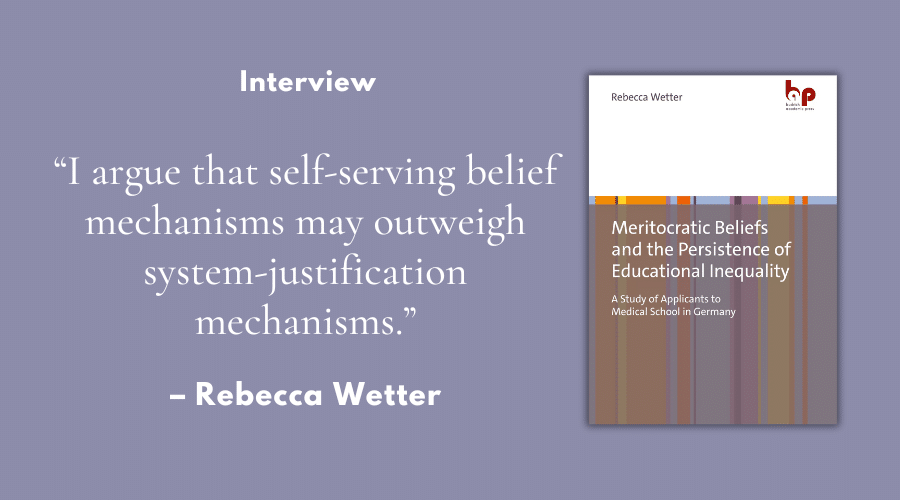
Der Bildungserfolg ist nach wie vor stark vom sozialen Hintergrund abhängig. In ihrer Veröffentlichung „Meritocratic Beliefs and the Persistence of Educational Inequality. A Study of Applicants to Medical School in Germany“ untersucht Rebecca Wetter, wie solche Überzeugungen durch Erfahrungen geprägt werden und welche Folgen sie für die Reproduktion bildungsbezogener Ungleichheit haben. Wir haben ein Interview mit der Autorin geführt.
Das Interview mit der Autorin können Sie auf unserem englischsprachigen Blog lesen: budrich.de/en/news/interview-rebecca-wetter
Über „Meritocratic Beliefs and the Persistence of Educational Inequality“
Educational success remains strongly linked to social background. However, there is no growing concern about this, which could be explained by meritocratic beliefs that success primarily depends on individual effort and talent. Rebecca Wetter examines how such beliefs are shaped by experiences and what consequences they have for the reproduction of educational inequality.
In her book, Rebecca Wetter explores a possible explanation for the presistence of meritocratic beliefs. She studies and discusses how these beliefs are shaped by parental education and educational experiences. Precisely, she examines how (differences in) inequality beliefs influence perception of justice, distributive preferences, and persistence in goal pursuit. To address these issues, the author combines sociological, socio-psychological and economic theories. She uses this theoretical framework and quantitative methods empirically by analyzing longitudinal data of applicants to medical school in Germany.
Auf unserem Blog können Sie weitere Interviews entdecken.