
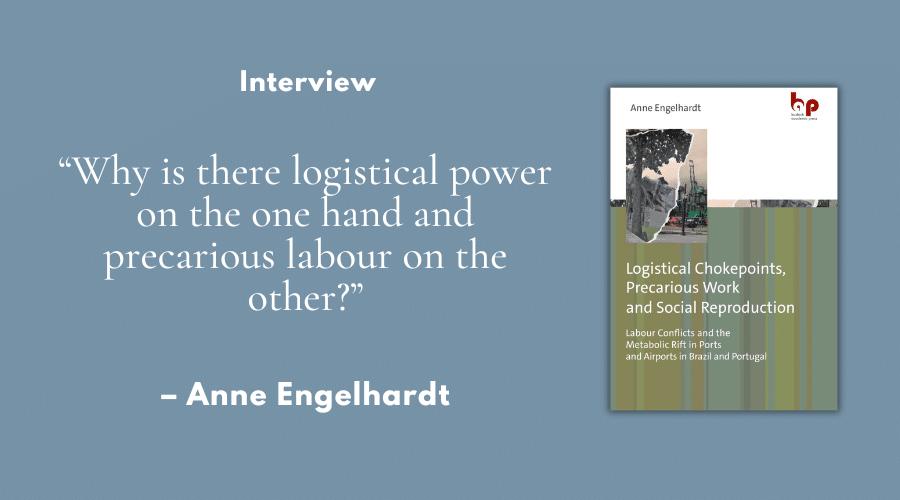
Sie arbeiten an den Dreh- und Angelpunkten einer globalisierten Wirtschaft, und doch sind die Arbeitsbedingungen für Arbeiter*innen an logistischen Schnittstellen wie Häfen und Flughäfen nach wie vor überwiegend prekär. Warum ist dies so? Wir haben ein Interview Anne Engelhardt, Autorin von „Logistical Chokepoints, Precarious Work, and Social Reproduction. Labour Conflicts and the Metabolic Rift in Ports and Airports in Brazil and Portugal”.
Das Interview ist hier auf unserem englischsprachigen Blog abrufbar: budrich.de/en/news/interview-engelhardt
Über „Logistical Chokepoints, Precarious Work, and Social Reproduction. Labour Conflicts and the Metabolic Rift in Ports and Airports in Brazil and Portugal”
Sitting at pivotal points of globalized economies, workers in logistical chokepoints such as ports and airports should have a lot of negotiating power. Examining the spatial-historical narrative of logistics in Portugal and Brazil, this book asks why working conditions in ports and airports are still predominantly precarious. Using her own field research and qualitative studies, Anne Engelhardt analyses the work and lives of workers along materialist theoretical approaches to social reproduction, the metabolic rift, the state and the body.
Based on these studies, the author is able to point out that precarious working conditions at transportation hubs not only include low wages and fixed-term contracts. Above all the working conditions are charaterised by problems in the area of health and safety at work. Engelhardt turns to theories of social reproduction (SRT) to understand the working body as a structure and actor in the metabolism or metabolism between production and reproduction.
Mehr Interviews und Leserproben gibt es hier auf unserem Blog.